My Nervous System Asked for a Coke
On burnout, and the cost of mistaking endurance for resilience.
Reading time: About 6 minutes.
“The ADHD part checks out,” Heather said as we threaded our way through Times Square, “but how do you fit with autism?”
Around us, giant screens flashed advertisements large enough to be seen from orbit. Music blasted from somewhere in the center of the street. Crowds surged one way and then another. Landlocked murmurations. We still had ten blocks to go before reaching The Lyceum, where we were scheduled to see Maya Rudolph in Oh, Mary.
I’ve known Heather since we were about twelve years old. We’ve survived adolescence and young adulthood together and remained friends all this time. We’ve shared music and a love of Faye Todd’s pickled okra. We’ve eaten at each other’s tables, belly laughed at each other’s jokes and foibles. If anyone had the right to ask, it was Heather.
By the time we reached Times Square, my nervous system was waving red flags.
Find shelter. Find quiet.
I looked around at the lights, the noise, the bodies pressing in from every direction and made a vague gesture.
“All this,” I said.
It wasn’t much of an answer.
A better answer lived in Los Angeles, three Septembers earlier.
The sun found my face the moment I stepped out of a restaurant where Mike and I had just had brunch. I'd had half a pot of coffee. I should have been energized. Instead my body felt heavy, and the sunlight hit the gravel parking lot with such force it felt like an assault from the ground and sky.
I sneezed. I always sneeze stepping from shade into sun. It was a millisecond of relief.
I started scanning for shade. There wasn’t any. Just an old picnic table with flaking red paint.
“Five minutes,” Mike said, looking at the Uber app on his phone.
I nodded. Words had been difficult all morning.
Inside the restaurant we’d been wedged between a rambunctious child and a family of enthusiastic talkers. Music blasted from overhead speakers. Every table seemed occupied. Every chair seemed too close to another chair. Nothing was objectively wrong, yet I could feel my “me-ness” shrinking before we’d even ordered.
I thought breakfast might help—and it did a little.
Then we stepped outside.
Ignoring the voice in my head — the one yelling about splinters — I sat down at the picnic table and pressed my hands into the hot wood for grounding.
When the Uber arrived, I peeled myself off the bench and climbed in. Mike had plugged in the Los Angeles County Museum of Art, and I watched the city slide past the windows.
The driver had the air conditioning set to minus one hundred. The cold air soothed me immediately. Then sunlight ricocheted off windows and chrome bumpers and windshields and found me all over again.
After too short a ride, the Uber deposited us at the curb outside LACMA, but the entrance felt a million miles away.
When we finally made it out of the sun and under the shade of a courtyard I felt air enter my lungs again. I stood there for a minute unsure if my feet were still under me.
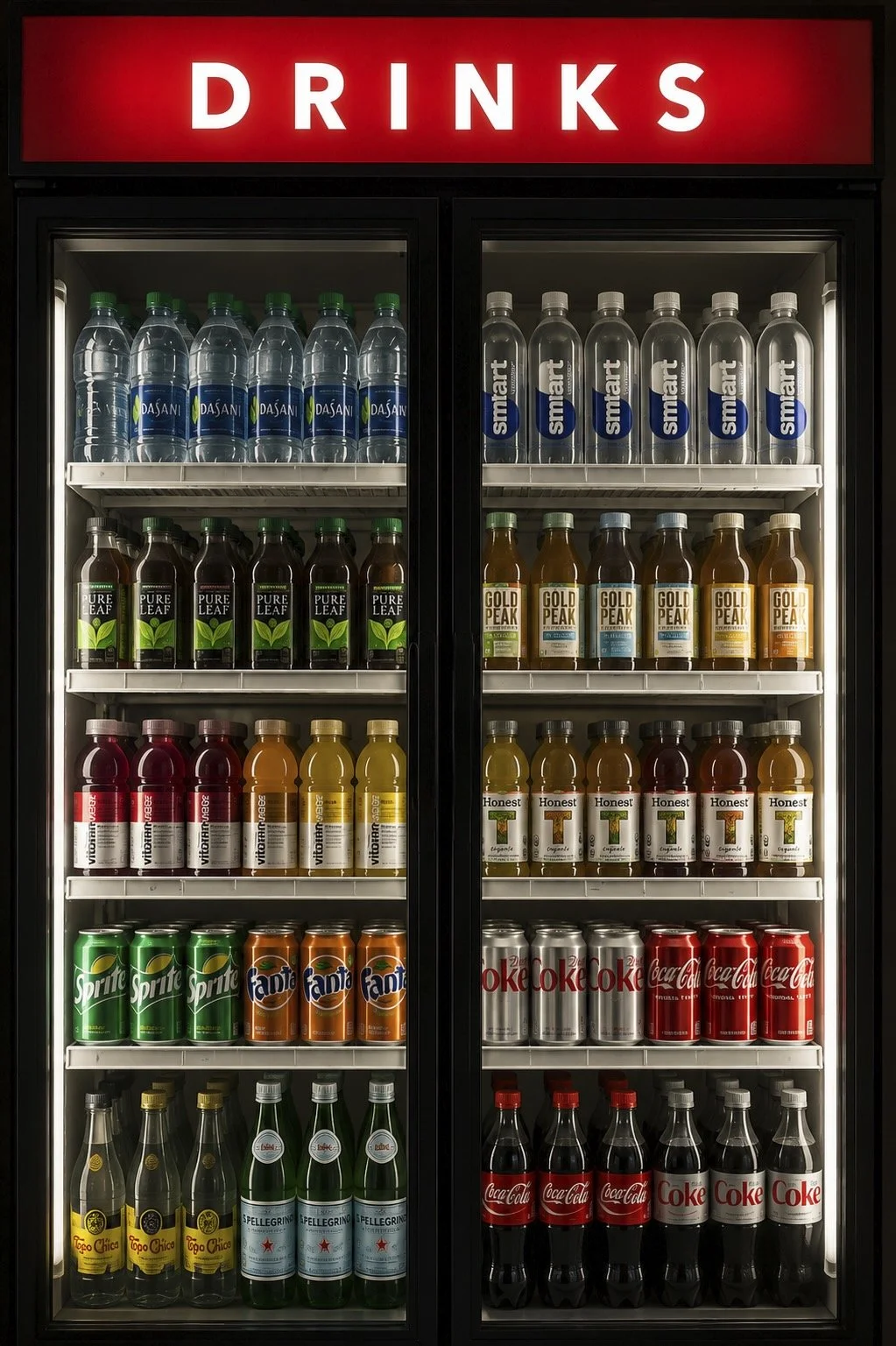
Across from where I stood sat a beverage cooler with DRINKS printed across the top in cheerful capital letters. Inside it were rows of bottled water, iced tea, sparkling drinks, and Coca-Cola.
I wanted a Coke with a certainty I usually reserve for emergencies.
Not coffee. Not water.
A Coke.
Cold. Sweet. Fizzy.
I could practically feel the bubbles before I tasted them.
But no, I thought. What about the corn syrup? What if I get diabetes?
I can’t have a Coke. I can’t need a Coke.
I’d spent decades practicing this particular skill: noticing exactly what I needed, then proving I could do without it.
So I followed Mike up the stairs. My arms and legs felt like wet sandbags. I could breathe, but it was like breathing through a thick cloth.
One of the reasons we came to the museum was to see an Alexander McQueen exhibit. I remember beautiful clothing. Dramatic silhouettes. A mesh face and head covering that sprouted buck horns. I don’t remember much else.
Later, standing in front of a painting, I found myself drifting toward it. Into it. As I looked at the colors and brush strokes, I felt myself floating toward the distance in the painting, sort of merging with the canvas. Then I realized I wasn’t floating. I was leaning, about to fall forward onto a priceless work of art.
Go get a Coke.
Instead I found Mike. Mercifully, he was ready to leave. Unfortunately, he was ready to leave for the Tar Pits.
We walked out of the museum, past the beverage coolers, and back into the brutal sun.
The petroleum smell hit about ten minutes later when we entered the park.
The tar bubbled lazily in the heat while the odor wrapped itself around my head like a tightening vise. I tried breathing through my mouth, then through my nose. Neither helped.
We took in all we could and then hurried back toward the museum plaza. Across the way stood the beverage cooler.
My last chance.
I had just stepped toward it when Mike pointed in the opposite direction.
“Our hotel is just a few blocks that way.”
I looked toward the hotel. Then toward the cooler. Then turned toward the hotel and began walking.
By then, my world had narrowed dramatically. One hand blocked the sun. One foot moved in front of the other. Whatever remained of my attention repeated the same instructions:
Look for traffic. Stop for the light. Don’t get hit by a car.
Back at the hotel, we gathered our bags and caught an Uber to the airport. The next thing I remember clearly is sitting at our gate while Mike studied my face.
“Are you okay?”
I tried to smile.
“Can you get me a Coke?” I asked.
He did.
I drank it slowly. The ice. The fizz. The sweetness.
Something inside me began to unknot.
When I got home, I brought the story to my therapist.
She listened for twenty minutes and then said, “Textbook burnout.”
I had heard the word before. But hearing it attached to that day, to the restaurant and the museum and the tar pits and the painting and the Coke I kept walking past, something shifted.
I could look back over my life and find that day everywhere.
In crowded stores where I suddenly needed to leave. At prom when I called my dad in tears to come pick me up. In meetings at work when I either clammed shut or overshared—there was no in-between.
For years I thought resilience meant pushing through. Now I wonder if resilience sometimes looks more like paying attention. Paying attention before the panic, the shutdown, before the world narrows to a single instruction: Don’t get hit by a car.
Heather never got a better answer that day in Times Square. But if she asked me again, I’d know what to say.
My nervous system has been talking to me my entire life. I just kept translating it as weakness.
And once, in Los Angeles, all it wanted was a Coke.