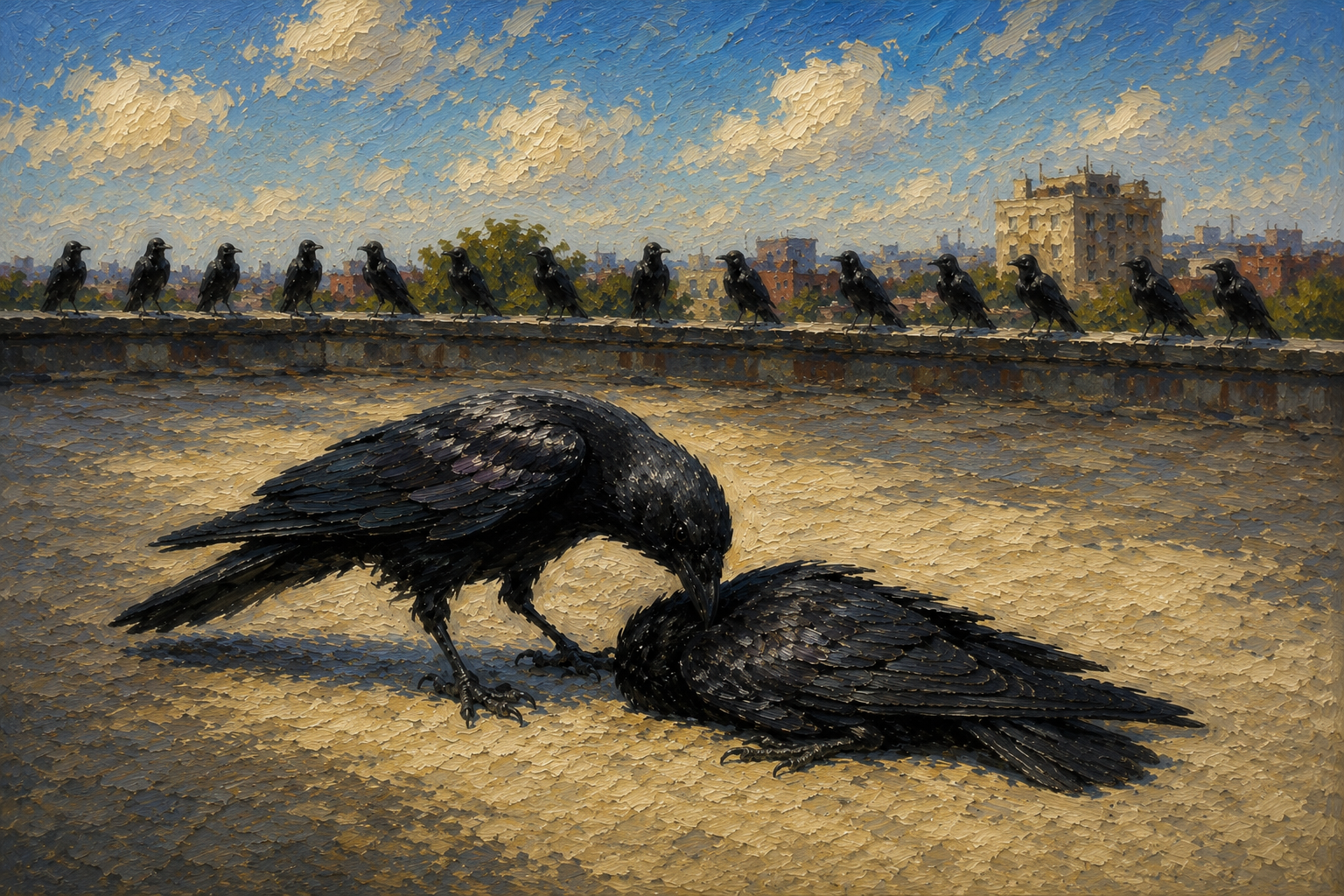
Image generated with AI.
Reading time: About 6 minutes.
An unusual racket of crows caught my ear one Friday morning in June. So much noise from so many crows usually indicates a bird of prey. They flock together, screaming, dive-bombing the intruder until he gets tired of being bothered and flies away.
Amid the familiar caw-caw of unsettled crows was a singular call that stood out. Higher pitched. More urgent. A sound that caught somewhere under my ribs before I understood why.
The first time I went to the window, I saw maybe fifteen crows standing on the ledge of the roof across the street. They were all pointed toward a single crow who stood beside a black splotch in the center of a gray water stain that discolored the rooftop. I couldn’t quite make it out. It blended so well with the dirty gray of long-dried rain that I wasn’t sure I was seeing anything at all. I shrugged, figuring the lone crow had found a food source the others coveted, and went back to waiting for my coffee to finish brewing.
But the noise continued.
When I got up for a second cup, I wandered back to the window. The crows hadn’t moved on. If anything, there were more of them now, and the lone bird had shifted her position. She had dragged the black splotch off the gray water stain and onto a section of roof painted the color of old cream. Against that pale background, the shape declared itself.
A bag, I thought first. Some trash carried there by the crow.
But bags don’t have that particular geometry, that triangle of two wings gone flat and wrong against the ground.
I squinted with a prayer that I was mistaken.
I wasn’t.
A dead crow.
Beside him stood another crow who was not merely standing near the body.
She was keeping watch.
I want to be careful here, because I can’t tell you what a crow feels. Researchers who study these gatherings are careful too. Some call them funerals. Fewer are willing to call them grief. I understand the caution. I just don’t share it. Not after that morning. What I saw kept asking to be translated into the only language I had for it, which was the language of my own grief.
The sound she made was unlike the others. It rose above the familiar cawing, higher and rougher, pulled from somewhere so deep inside her that for a moment it was the only sound in the city. The other fifteen never answered in kind. They watched. They called to one another. But that cry belonged only to the guardian.
She lowered her head and pressed her beak against the still breast of the crow who had been. Once. Twice. Again. Like crow CPR. Then she waited, as though listening for an answer that refused to come. After a few moments she pressed him again.
Another crow broke from the line and fluttered toward them. The guardian erupted. She rose to meet the newcomer, screaming, putting her whole small body between the visitor and the dead. Then she seized the fallen crow by one wing and dragged him several feet across the roof, farther from the others.
The second crow lifted away without protest and returned to the ledge.
They all seemed to know what the guardian could not yet bear to accept.
There was no going back.
I abandoned my work that morning in small increments. Every time I stood to make the bed, wipe the kitchen counters, water the plants inside or out on the balcony, I found myself detouring to the window. It felt intrusive to watch, as though I’d stumbled into something private, but I couldn’t quite stay away. My heart had attached itself to the guardian.
As I watered the flowers outside, I watched one or two crows leave the ledge and flutter cautiously toward her. She screamed at them, too.
Some of the others came closer during that hour, in ones and twos, the way people edge toward a hospital room they’re not sure they’re allowed to enter. They didn’t touch the body. They stood near the guardian instead, heads tilted, staying only a few moments before retreating again. She never turned toward them, but after a while she stopped driving away the ones who simply wanted to stand nearby.
Little by little, the gathering began to dissolve. Some crows left the ledge for the tall tree that overhung the roof. Others launched from its branches toward parts unknown. One bird lifted away, then another, until the morning slowly reclaimed its ordinary rhythm.
The guardian remained.
She gave the wing a few more gentle tugs, but the movement had changed. Less wake up. More I don’t want to let you go.
Then she did the thing that undid me more than any of the screaming had.
She groomed him.
She ran her beak once, carefully, down the feathers of his neck, the same gesture I imagine she’d made a thousand ordinary mornings before this one, when it meant nothing more than good morning or I’m here. It was the last tenderness available to her, and she offered it.
By then I had begun taking my cues from the crows. As more of them drifted away, I returned to my writing, though every trip to refill my coffee, every walk to the bathroom or the kitchen, found me stopping once more at the window.
She was still there.
Until she wasn’t.
When I finally looked up and found the roof empty, my heart broke all over again. Not because I expected her to remain there forever, but because I knew what her absence meant.
She had let go.
What remained on the cream-colored roof was a black splotch. Not a brother. Not a mate. Not a child. Just a shape again, the way it had been before I knew how to see it.
For days afterward I found myself going back to the window to check on the body. Not because there was anything left to do for it, but to see if it was still there. In the same way you check a door you already know is locked. The body was always there. I was always a little surprised.
Weeks later, I still look sometimes. The rooftop has returned to being what it always was: a gray water stain, a cream-colored patch, the ordinary geography of a building I’ve looked at for years without really seeing. The crows still land there. They call to one another. They go about the unbothered business of being crows.
I don’t know what the guardian carried with her after she flew away. I don’t know whether she remembers that cream-colored patch of roof, or avoids it, or has already forgotten there was ever a reason to.
I only know what I carried away from the window: the memory of one bird who kept watch over another until she could no longer ask him to stay.