Letting Go of the Handrail
On buses, improv school, and the man who taught me everything about both.
Reading time: About 8 minutes.
In the first weeks of 2019, I rode the 124 bus every Monday evening from downtown Seattle to Georgetown, a scruffy, storied neighborhood at the southern edge of the city. I was on my way to improv school. I had signed up on a kind of dare to myself.
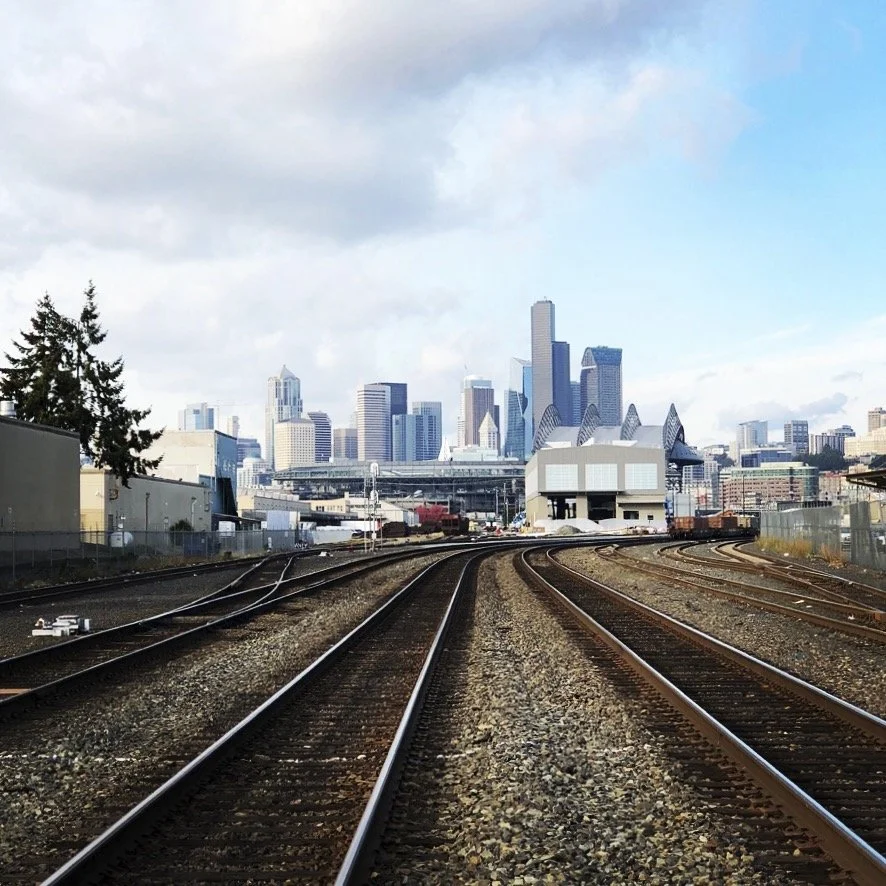
The bus made its way down 3rd Avenue, a street that belonged entirely to buses. Out the window, the city shifted from sparkling newer buildings to older, unkempt ones, past parks with dogs and their owners, past an empty fountain where clusters of people stood looking hunched and disheveled, as if the world had churned them up and spit them out. Past warehouses, over railroad tracks where there was always something different to see each week — a tent, scattered shoes along the rail line, a stuffed unicorn resting against a light pole. Each week a new life story told in solitary objects.
The warehouses gave way to trees, then old brick buildings. I got off and walked the rest of the way to improv school.
When I ride the bus, I try not to make too much eye contact, but I scan at every stop to see who gets on. I notice things. I’m touched when someone stands to give an elderly woman their seat. I find it quietly delightful when the front of the bus — populated by wheelchairs and people who can’t manage the aisle steps — chatters away like a cocktail party. One afternoon, they took turns fanning each other with a file folder while complaining about the heat. Drivers receive their passengers differently too. Some are warm, offering a joke at each stop. Others are school principals: “Whoever’s smoking that joint better put it out before I pull this bus over and make everybody late.” There are riders who wave as they exit and holler “Thank you!” And, of course, there are those who do not.
My favorite passenger hopped on somewhere in SODO, Seattle’s industrial district, wearing a crown made of toilet paper and leafy twigs, the paper tied at the back of his head and trailing behind him like a queen’s train. His face was dirty and he had few teeth left, but his eyes shone like a cherub’s. He was happy.
“Hello, everybody!” he said, clambering onto the bus with a paper bag clutched to his chest. He looked around for a seat and — I’ll admit it — for a moment I worried he might sit next to me. But he chose the seat across the aisle and smiled as he dug through his bag to pull out a long stick of beef jerky.
“Hey,” he said, turning to the man beside him. “I got a whole bag of beef jerky. Want some?” The man shook his head and lifted a hand in a silent no.
He shifted toward the people behind him. “I got beef jerky and apples,” he said, offering his bounty. They smiled politely and declined.
Then his sparkly eyes turned to me. “You want some? I have enough for everybody.”
I held up a hand. “No, thank you.”
“Jeesh! Nobody wants beef jerky?” He waved the bag in a wide arc. The smell wafted over me. He took a big bite. “Who doesn’t love beef jerky?”
Then he happily set about eating it by himself.
When my stop came, I waved to the bus driver and stepped onto a sidewalk next to Georgetown Pizza and Arcade. The air smelled of pizza and railroad ties. I walked through the parking lot, crossed a set of railroad tracks — always a little unnerving, standing that close — and came out into a community park buzzing with kids playing soccer, couples playing tennis, dogs barking, grandparents singing to babies in strollers.
I wove through the park and walked the last few blocks past beige office buildings and newly built homes standing next to homes that were a hundred years old. At a plain glass door, I punched in my security code and pulled it open. For the next two hours, I was expected to let go of everything I knew about how to behave.
The classroom looked like an empty conference room in any midsize corporation. The carpet was thin and industrial beige. The lighting was bright and fluorescent. A single window, too small for the room, looked out on a parking lot. A folding table against one wall held snacks and beverages when anyone thought to bring them. Folding chairs leaned in precarious rows just inside the door — though as the semester rolled on, we learned to arrange them in one long row along the wall, the better to watch each other fail and recover.
There were about twenty of us, and we had all arrived with different dreams and varying degrees of certainty about our own talent. Leo was the most at ease among us. His dark eyes sparkled when he laughed, which he did easily, making everyone feel funnier than they probably were. John with his trucker’s cap and 90s flannel-as-jacket was a blue-collar Seattleite who’d seen Pearl Jam and Nirvana before anyone knew who they were. Michael treated improv as a stepping stone to stand-up comedy and made every scene about himself — until the day he picked up an imaginary stuffed toy and delivered its eulogy with such sincerity that I nearly cried.
Improv, I discovered, is not about being funny. It’s not about being quick, or clever, or saying the quippiest thing in the room. It’s about saying yes to whatever arrives — yes, and — and then adding something of your own. Simple, in theory. Excruciating, in practice, if your brain is the kind that takes in every gaze in a room and interprets each one before you’ve opened your mouth.
Jill Farris, our instructor, warmed us up each session with games designed to short-circuit exactly that kind of thinking. Zip, Zap, Zop: make eye contact, pass energy around the circle, fast, no pausing to consider. Don’t think. Just go. By the time the “zop” reached me, I’d forgotten whether I was supposed to say zip or zap and was mentally reconstructing the previous six turns like rewinding a movie to catch the moment a hero knows who she is. There is no time for reconstruction or analysis. I could not stop doing this.
Part of the problem was that I had spent a lifetime paying attention. One evening on the way home from somewhere else, I listened to a woman detail what sounded like a contagious skin disease to some medical professional over the phone. I wondered where she got such a thing, why she would share it so openly on a bus, and whether I should move further away. Was it that contagious? I spent the rest of the ride writing her story. I do this everywhere — grocery stores, coffee shops, waiting rooms. A stranger’s expression, a discarded object, a snatch of overheard conversation, and some part of me is already spinning the thread.
But attention has a shadow side. After years of studying other people, I learned to study myself with the same intensity. I became both performer and audience, narrator and critic. Long before I spoke, some part of me was already evaluating how my words might land.
And experience had taught me there were reasons to do that. More than once, I had gushed over a beloved book or movie, or stood on a stage to try out for cheerleader or ask for votes in a student election, only to be met with mocking eyes, stifled giggles, or outright rejection. Little by little, I learned to keep a hand on the reins. Improv was asking me to do the opposite.
I don’t remember what the scene was supposed to be. I don’t remember the setup or what imaginary world I was standing in. What I remember is Leo’s face in the front row, and John’s, both of them open and waiting, and something in me — for the first and only time — simply let go of the handrail.
I don’t know how long it lasted. Long enough that I stopped monitoring myself, stopped checking the room for reactions, stopped running the internal audit that had followed me through every previous class. I was in the scene the way the beef jerky man was on the bus — fully, without apology, without calculating the effect.
And then I became aware, slowly and then all at once, of where the scene had gone. I was dancing, slowly, hips swaying, arms reaching toward the sky. When I looked out, their faces were turned toward me like they were waiting for something, and for once I didn’t mind.
Jill stopped the scene.
I don’t know what expression crossed her face. Surprise, perhaps. Concern. Maybe she simply felt the scene had run its course. Whatever it was, I experienced it as judgment. Before she could say a word, I had already supplied the verdict myself. I sat down burning with shame.
I have thought about that moment many times since. Not because I know what Jill was thinking, but because I know what I was thinking. The one time I did the thing I came there to do—really did it, without flinching—I felt I had gone wrong in exactly the way women are not supposed to go wrong. Too much. Too far. Too bodily. Too free.
I never registered for another class after that. But I think about the man with the crown sometimes. How he walked onto a bus full of strangers and offered everything he had — beef jerky, apples, good cheer — and when every single one of us said no, he felt nothing but mild surprise. No shame. No adjustment. No verdict. He just took a big bite and enjoyed his lunch. I have wondered, more than once, what it would feel like to be that free. To offer the whole bag and not need anyone to take it.
By the time the semester ended, I was fairly sure I wouldn’t sign up for Improv 200. But standing outside with Leo and John and Claire on that last night, feeling the spring air on my face, taking in the stars over Georgetown, sharing laughs I hadn’t expected to share with people I hadn’t expected to know, I understood that something had happened to me anyway.
Whenever I start calculating the right thing to say, I think of the man on the bus with a toilet paper crown and a bag of beef jerky. He offered the whole bag and survived everyone’s refusal. That’s a lesson I spent a semester trying to learn and he carried it around in a paper sack.