Part IV: For 1956 and For Now
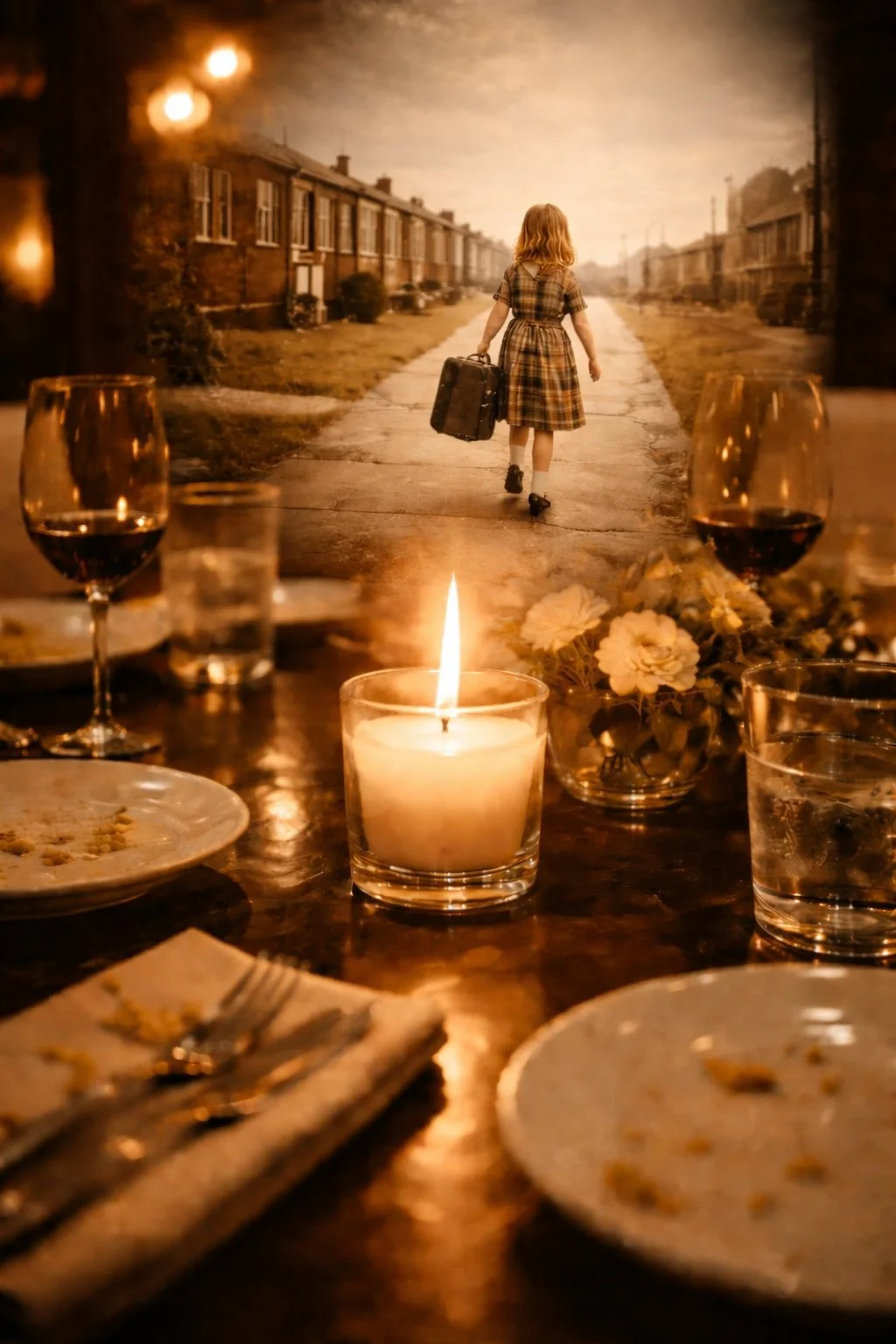
Reunion memories. Image created with AI.
This essay is Part IV of a short series about my mother’s adoption in 1956. It is based on events I witnessed and stories my mother shared with me over the years. Some names have been changed to protect privacy.
She had carried things her whole life.
The black cardboard suitcase at ten, rough against her palm, heavy enough to pull her sideways. The letter she had written and never sent, folded and pocketed by someone else’s hand. The necklace in its pale blue box, wrapped in cotton so it wouldn’t shift.
She had learned to hold what mattered close and leave the rest.
But tonight, crossing a parking lot in the cooling dark, seventy years pressing hard on her body, she felt the full weight of everything she had ever carried arriving in her chest at once.
She tightened her grip on her husband’s arm.
Not because the ground was uneven, but because in a few seconds she would be standing in front of the brother and sister she had last seen on a Baltimore sidewalk sixty years earlier — Sam scuffing his heel against the step, Rose’s arms crossed tight, the suitcase pulling her sideways as she walked away.
Her neck flushed warm. Had they forgiven her for going? Would walking through that door answer the question or deepen it?
She had learned, over the years, to trust the part of her that kept moving even when she was afraid.
She closed her eyes. Breathed out. And reached for the door.
⸻
The room was warm. Light moved across the black table, caught the rims of waiting glasses, pooled in the soft cream leather of the chairs. A fireplace at the far end stood solid and quiet.
Edith rested her hands on the back of a chair and felt the leather cool and smooth beneath her palms.
Her pulse was in her throat.
She had stood in enough rooms in her life to know how to inhabit one — how to arrange her face, how to hold her shoulders, how to be present without giving too much away. She had been practicing this since she was ten years old. She was very good at it.
But her hands wouldn’t quite settle.
She pressed them flat against the leather and waited.
When the door opened she knew before she looked. Something in the room shifted — the air, the light, something she felt in her sternum before she saw it with her eyes.
She looked up.
Softer at the jaw, lined at the eyes, the particular weathering of lives fully lived. Older. But underneath — the slope of the nose, the set of the mouth. Edith recognized the way the woman in the doorway held her shoulders, careful and contained, in the same way she recognized her own handwriting.
Rose.
And beside her, already moving, already smiling, a warmth coming off him like a candle that had never gone out:
Sam.
Bone recognizing bone.
“We’d know each other anywhere,” Sam said.
Awkward laughs. Bodies shifting. No one quite knowing where to put their hands.
Edith smiled and felt her face doing the right things and was aware, distantly, that she was still holding the back of the chair.
She made herself let go.
⸻
The candlelight at their table circled them close while the rest of the room fell away. Other tables, other evenings, fading to dark at the edges like a photograph of a moment too important to share.
Just this table. Just these faces.
She felt it move through her before she could name it. A shudder, small and sudden, traveling from her chest outward. The faces around this table were not strangers’ faces. They carried something she recognized — not just in their features, but in the way they held themselves, the way they tipped their heads when they listened. She had seen this before. She saw it every morning in the mirror.
She had been the only one of herself in every room for sixty years.
She was not the only one now.
The feeling that moved through her had no single name. Recognition. Disbelief. Curiosity. A small, startled delight she hadn’t expected to feel, hadn’t let herself anticipate. Kinship, arriving in her body like a word she had known how to spell but never heard spoken aloud.
Seen.
She held it carefully. Didn’t let it show. But it was there, present beneath the surface, running quietly through the careful conversation that followed — the careers and children and decades of work, the inventory of lives lived out of sight of one another. She listened. She asked questions. She kept herself arranged.
And then Sam said something wry, perfectly timed. It was the kind of observation that lands differently when the person making it looks like you. She laughed.
A real one. From deep down.
Her shoulders relaxed. She looked at Sam across the black table. He had an expression that was kind and quietly glad.
She thought: There you are.
Not the boy on the stoop. Just Sam.
Sam started talking about West Virginia. Mama’s mountains. The train they’d taken as children.
Something shifted around the table.
The distance closed. The circle of light felt smaller and softer. Edith found herself more present than managed, more herself than careful.
It was in one of those moments that Rose said it — quietly, the way she said everything, as if testing the weight of the words before she let them go.
She had almost been sent away too, she said. The same people. Their father had stopped it — had pulled up furious one afternoon, told her to get in the car. Said he would not lose another child.
The table stilled.
Edith sat very still and felt the words rearrange something in her chest. Her father had let her go. She had always known that. Had turned it over for sixty years, felt its edges. But she had not known what it had cost him. Whether he had understood, afterward, what he had done.
He would not lose another child.
Grief and relief arriving together, the way they sometimes do.
She looked at Rose. Rose looked back, careful, contained, something held just beneath the surface. Edith recognized it. She had worn that same expression for as long as she could remember.
She nodded, once.
Rose nodded back.
Then Rose set her fork down.
Something had gone quiet in her face. She wasn’t looking at anyone. Her gaze had moved somewhere past the table, past the room, fixed on a distance only she could find.
The room fell silent.
Edith felt her own breath go shallow.
“I remember that day.” Rose’s voice was barely above a whisper. “You were walking down the sidewalk with that little suitcase.”
Edith held her breath.
“I stood there and watched you go.” Her voice barely holding. “I didn’t know where you were going. I didn’t know if you were coming back.”
Her voice broke.
Nobody moved.
Edith looked down at her hands.
She looked up — not at Rose, but down a street she hadn’t stood on in sixty years. She had kept walking because the adults said to, because Mama said this was her chance, because her feet kept moving even when everything in her had wanted to stop.
She had never looked back. She had not known, until this moment, what she would have seen if she had.
Her sister. Still standing there. Watching her go.
She felt the tears before she was aware of crying. Brushed them back quietly.
Rose’s eyes were wet, too. The careful containment gone, something younger and rawer in its place.
“I’m sorry,” Rose said softly, the apology directed at her own tears, at the space they were taking up.
Edith felt the smile come before she could stop it. Small. Slightly embarrassed. The kind that surfaces when you recognize yourself in someone else so completely that there is nothing left to do but smile.
They were so alike, the two of them. The same careful containment. The same lifelong habit of apologizing for their own feelings in public. The same face, or close enough to make Edith’s chest ache with the recognition of it.
“I didn’t know,” Edith said, her voice small.
Across the table, Sam’s eyes shone. Someone reached for someone else’s hand.
They had all been children. They had all been standing on that sidewalk in one way or another, watching someone walk away, not knowing if they were coming back.
None of them had ever stopped looking.
⸻
At the end of the meal, Sam stood. No one mistook what he was doing.
He came around the table the way a man moves when he knows exactly where he’s going — no announcement, no hesitation, just the quiet fact of him crossing the room toward her.
Edith rose to meet him without thinking, her body understanding before her mind did.
He opened his arms.
She stepped into them carefully.
Her body went tight the way it does when it doesn’t yet know if it’s safe to stop being careful. Sixty years had left their mark on her muscles, her breath, the precise angle of her shoulders.
His arms wrapped around her shoulders. Steady. Sure. Unhurried.
She felt something give.
He stepped back. Looked at her, his hands still on her shoulders. His eyes were wet, though he seemed determined not to notice.
“That one,” he said, “was for 1956.”
The year settled over them like a stone set down after a long carrying.
Edith felt it land in her chest. She understood now that it had meant something, just not what she’d thought.
He drew her in again.
This time her body knew what to do.
Her hands found his back and stayed there. Her shoulders released. She leaned into him the way you lean into something solid when you have been standing alone in a wind for a very long time.
Not as a guest, but as his sister.
Her breath caught once before it steadied.
When they stepped apart, both their faces were wet.
Neither of them pretended otherwise.
⸻
Outside, the night air was cool against her face.
She breathed it in fully, freely, without having to think about it. Her body felt lighter. Her steps more sure on the uneven ground.
She had carried a question for most of her life. Older and simpler than the one she had named in the parking lot.
Did it matter that I was gone?
She knew the answer now.
Her father had never signed the adoption papers. Not when she left, not in the years that followed. Whatever he had told himself about letting her go, he had never been able to put his name to it and call it done. Edith had signed them herself, at eighteen, quietly, without drama, closing the door he couldn’t close, giving everyone permission to stop waiting.
She had wondered, sometimes, what he had been waiting for.
Rose had given her something toward an answer tonight. Not absolution. Not a rewriting of what she remembered. Just one more thing to hold alongside everything else. A man capable of regret. A father who, in the end, had planted his feet.
She had not escaped something loveless.
She had been loved enough to be missed.