Part III: Where Home Is
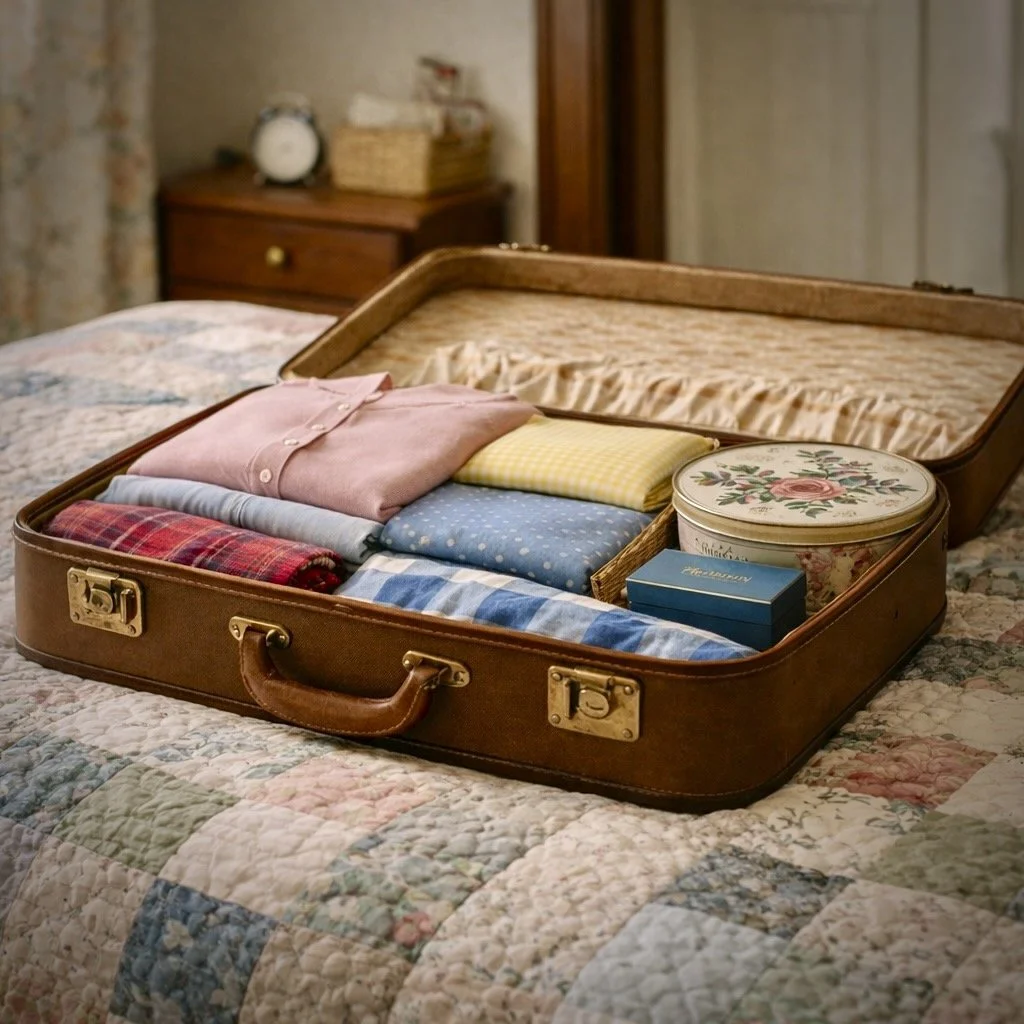
Imagined version of Edith’s suitcase. Image created with AI.
This essay is Part III of a short series about my mother’s adoption in 1956. The scenes are imagined, shaped by the stories she carried with her and shared with me over the years. Some names have been changed to protect privacy.
Edith’s suitcase lay open on the bed.
Its sides gaped wide, like the open mouth of a baby bird.
This one was bigger than the one she had carried as a child. Sturdier. It smelled faintly of mothballs and fresh laundry. She folded each thing carefully. Skirts smoothed. Blouses aligned. Socks and nylons paired and tucked inside her shoes, the way Florence had taught her years earlier.
Nothing rushed. Nothing careless.
She had been one of the few girls in her high school class anyone expected to go. Some of them were already engaged. One was already married. Edith had known since she was fifteen that she was going. She had tried on other futures first — said yes when asked, felt the particular heft of a ring on her finger — and known, both times, that the fit was wrong. And each time, she had learned to trust that kind of knowing, the quiet kind that didn't ask permission and didn't need to explain itself.
Florence moved in and out of the room with purpose.
“Here, Shug,” she said, setting a small bundle on the bed. “You’ll want this where you can get to it.”
Bandages. A tiny tin of aspirin. A safety pin folded into a scrap of paper. Practical. Thoughtful. Love, expressed as preparedness.
Edith smiled. “Thank you, Mother.”
Florence nodded, satisfied. Then she reached for one of Edith’s sweaters and refolded it. Not because it needed it, but because order was how she kept worry from spilling over. Her hands moved briskly, efficiently, as if staying busy might hold something else at bay.
From the other side of the house came the sound of the side door opening. Closing.
Papa.
He had been in and out all morning. The garden. The garage. The sink for water. The living room where the newspaper sat half-unfolded and unread. Moving through the house the way he did when something sat heavy on him. Not avoiding her exactly, but not finding her either.
Each time she heard his footsteps, her shoulders tightened. She had been waiting for days for him to say something. To tell her she was making a mistake. That she was reaching for something that wasn’t hers to reach for. That his love, like everything else in life, had terms.
He hadn’t said any of it.
She didn’t know yet if that was good news.
She kept packing.
The windows were open to the September air. She lifted her gaze to the fluttering curtains and smiled. Her room smelled like sunshine and the date loaf Florence had baked that morning. Once it cooled, Florence had wrapped it carefully and slid it into a tin lined with wax paper.
“You’ll want something from home,” she had said.
Edith tapped lightly on the tin and found a spot for it in her suitcase. She turned to her dresser.
Tucked into the back of the top drawer was a small square box. Pale blue. The name of Wright’s Jewelers emblazoned in gold lettering across the top. Inside, a silver heart rested where it always had, its surface still bright despite the years. The chain pooled softly beneath it.
She lifted it into her palm.
She remembered standing beside Florence at the jewelry shop window. The way they had both paused. The smile Florence had given her. And later, the box. One necklace for each of them.
A mother and daughter. Not by blood, but by choosing each other, day after day.
Edith wrapped the chain around a square of cardboard so it wouldn’t tangle. She placed it carefully in the box with her favorite pearl earrings and tucked cotton on top of everything to keep it still.
She set the box in the corner of the suitcase and closed the lid. Pressing her tongue lightly against her upper lip, she snapped the latches shut, one by one, until they held.
She rested her hand on top.
For just a moment, she let herself think of the other suitcase. Black cardboard. A mint green dress folded inside. Hands that trembled over it. She had been ten years old and she had believed, standing in that doorway, that she was coming back.
She had not come back.
But she had arrived somewhere. That was what she hadn’t known to hope for then — that arriving was its own thing, separate from returning. That you could belong to more than one place, even if one of them only lived in you now.
She lifted her hand from the suitcase.
The familiar drop in her chest — the feeling she had known as a child, when leaving meant losing everything at once — didn’t come.
Instead, there was a strange, steady pull forward.
Behind her, the doorway filled.
Papa stood there, his ball cap twisted in his hands.
He didn’t come farther into the room. Didn’t sit. Didn’t tell her what would be easier, or safer, or closer. His jaw moved once, the way it did when he was swallowing something back. She had seen that look before. She knew what it meant when Jack Keaton decided a thing was better left unsaid.
Edith waited.
She had been waiting for this moment all morning, for his face to tell her what his silence hadn’t. For the careful withdrawal she knew he was capable of, the warmth that could simply stop, like a door closing from the inside. She had seen it happen to others who had disappointed him. She had spent years making sure she wasn’t one of them. She knew the walls of his world well enough to know she was standing at the edge of one.
Jack cleared his throat.
“You’re all packed?”
She nodded. “Mother helped.”
A pause.
He shifted his weight. Looked down. Looked back up. His blue eyes were wet, though he seemed determined not to notice.
“You know where home is,” he said.
That was all.
No warning. No withdrawal. No proof that his love had terms after all. Just truth, plain and steady. That was all she needed.
Something loosened in Edith’s chest. The ache of leaving was still there, but it no longer felt like loss. It felt like movement.
“I do,” she said.
He nodded once, sharp and final, as if sealing it. Then he turned away before she could see if the tears fell.
A little later, Florence hugged her longer than usual, cheek pressed into Edith’s hair.
“Write when you can, sweetheart,” she said. “And don’t forget to eat.”
“I will,” Edith promised.
When the car was ready and the suitcase carried out, Edith took one last look at her room.
The bed smoothed. The dresser cleared. The life she had learned to fit herself into.
She walked out without looking back again.
Not because it didn’t matter. But because she knew where she was going.
Harding was waiting. And somewhere beneath that — steadier than hope, quieter than ambition — was the life Mama had seen in her before she could see it herself. The one she had been brave enough to send her toward.
Edith had spent years learning to fit herself into a life someone else had imagined for her.
Now she was walking into one she could imagine for herself.