Part II: The Last Letter
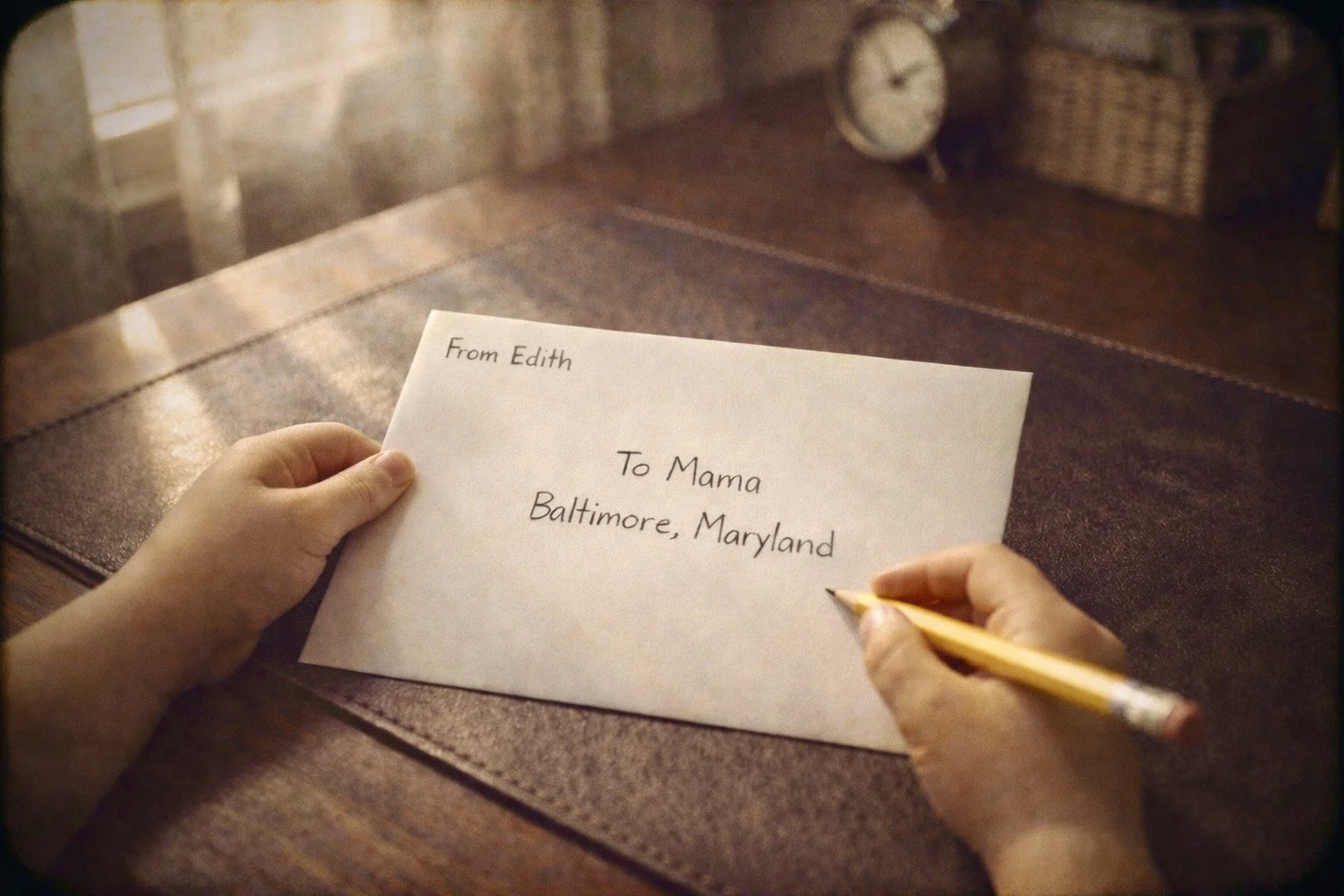
Imagined scene of Edith’s hands addressing a letter to Mama created with AI.
This essay is Part II of a short series about my mother’s adoption in 1956. The scenes are imagined, shaped by the stories she carried with her and shared with me over the years. Some names have been changed to protect privacy.
Edith finished her chores that afternoon the way she’d learned to do everything since arriving in Oklahoma—careful, thorough, eager to do it the right way. She swept the kitchen floor, gathered the crumbs into a neat line, and carried the dustpan outside just as Mrs. Keaton had taught her to do. When she came back in, she wiped the counter once more for good measure.
“That’ll do, Shug,” Mrs. Keaton said, glancing up from the sink. “You can go on now.”
Edith felt the small lift of relief that came with approval. She didn’t rush. She never rushed. She washed her hands, dried them on the towel hanging by the stove, and walked into the living room.
The house was quiet in the afternoon way. No radio was playing. No voices were drifting in from open windows. Light fell across the carpet in long, pale rectangles. Against the far wall stood the desk, its surface clear except for a lamp, a blotter, and a small stack of neatly aligned papers.
Edith sat down carefully, enjoying the tiny squeaks the chair made when she settled into it.
She opened the top drawer. Clean, uncreased paper. She took one sheet and closed the drawer again. In the second drawer: pencils, sharpened and lined up tip to eraser. Everything in its place. She chose one and held it for a moment, feeling the weight of it in her hand.
She knew exactly who she was going to write to—Mama.
The words came easily once she began. She wrote about the food first. The fried chicken, the biscuits, the way the green beans tasted different here. She wrote about the house and the porch swing and how quiet the nights were. “I never knew cicadas could be so loud!” She wrote about how Mrs. Keaton liked things done just so, and how Mr. Keaton laughed when she helped in the vegetable garden.
She didn’t write that she missed Mama.
She didn’t want to make her worry.
She wrote about school starting soon. About how they’d talked about her class. About how everyone had been kind to her. She pressed the pencil harder on that line, wanting it to be true in a way that could travel through the mail.
At the bottom of the page, she paused.
There were still things she wanted to say. She would save them for later, when there would be more room.
She folded the paper carefully, lining the edges up the way she’d been taught, and inserted it into an envelope. She wrote Mama’s name on the front, her address, each letter steady and clear. She licked the adhesive on the flap and sealed it with her thumb, smoothing it flat.
Only then did she realize what was missing. A stamp.
Edith slid off the chair, letter in hand, and walked back toward the kitchen.
“Mrs. Keaton?” she said softly. “May I have a stamp, please?”
Mrs. Keaton dried her hands and turned. She looked at the envelope, then at Edith’s face. For a moment, she didn’t say anything.
“Come sit down, Shug,” she said finally, pulling out a chair at the kitchen table.
Edith obeyed. She set the letter on the table between them.
Mrs. Keaton reached for it slowly and picked it up, her eyes flicking to the address, just long enough for Edith to notice the faint tightening at the corner of her mouth.
“These last few weeks with you have been so nice,” she said. “It takes a little time to get your feet under you in a new place. Best not pull yourself in too many directions right now.”
Edith sat up straighter and nodded. She nodded at everything now.
“I’ll hold onto this for a while,” Mrs. Keaton continued. “Maybe we’ll send it later.”
Later.
Edith watched as Mrs. Keaton slipped the letter into the pocket of her apron. The shape of it was still visible under the floral gingham fabric.
She kept her eyes on that pocket.
Mrs. Keaton had never been unkind to her. Not once.
That was the thing Edith kept turning over as she sat there, her hands still in her lap.
There was warmth in this house. Real warmth. The kind that came with a chair pulled out for you, a name said softly, a counter wiped clean together. Mrs. Keaton wasn’t pretending. She wasn’t performing. She wanted Edith here. Edith could feel that she was wanted.
Mrs. Keaton stood and went back to the sink. The water came on. A dish clinked.
Ordinary sounds.
Edith sat very still and looked at her hands.
But the wanting had a shape to it. There was a version of Edith who fit inside that shape, and a version who didn’t. The one who fit had her feet under her. Her eyes forward. Her letters unwritten.
Mrs. Keaton wasn’t taking the letter.
She was taking Mama.
She had sealed the envelope with Mama’s name on it. She had licked the flap shut with her own tongue, tasted the thin, papery bitterness of the adhesive. She hadn’t written “goodbye.” She never really thought she’d ever have to say it.
There would be no goodbye now.
She thought about what she had not written. That she woke up some mornings and forgot, just for a second, where she was—and that the second before she remembered was the best second of her day. That she had started hiding food in the storm cellar behind the canned peaches, and that she didn’t know exactly why. That sometimes she stood at the kitchen window and looked out at the flat Oklahoma sky and tried to remember what Baltimore smelled like, and it was already getting harder to find.
None of that would travel through the mail now.
And slowly, sitting at Mrs. Keaton’s kitchen table with the water running and a dish clinking and the afternoon settling around her like dust, something became clear.
She could belong here.
She could have this—the order, the approval, the small lift of relief when she did a thing right, the voice that called her “Shug” like she was something precious.
She wasn’t sure she was allowed to hold on to any other way.
She only knew, sitting there with her hands in her lap and Mama’s name resting in someone else’s pocket, that the choice had already been made.
Not by her.
But she would have to live inside it.
She eased off the chair and walked back into the living room.
Afternoon light stretched across the floor in warm, fading stripes—the color of the hour before dinner, when the day had given most of itself away. Edith stepped into it and sat down, letting the light settle over her face and hands.
She thought of Mama’s address in her own careful handwriting. Each letter steady and clear.
I will remember how to write it. I will not forget.
It was the only promise she could make. The only thing still hers.
And as she sat there, the warmth pressing soft against her closed eyelids, something inside her closed too. Quietly, the way a door closes when no one is watching. Not slammed. Not locked.
Just shut.
There’s a version of this story where Mrs. Keaton was a villain. It would be easier, in some ways, to tell it that way.
My mother never told it that way.
She told it the way people tell stories about being loved imperfectly — with a careful sorrow, a refusal to condemn what she also could not fully forget. The life she had come from was fractured. Mama had loved her fiercely enough to let her go. Mrs. Keaton had wanted her enough to hold on too tight. Everyone, in their own way, had seen her clearly.
But she was ten.
No one knew how to tell her that.