Part I: No One Said Goodbye
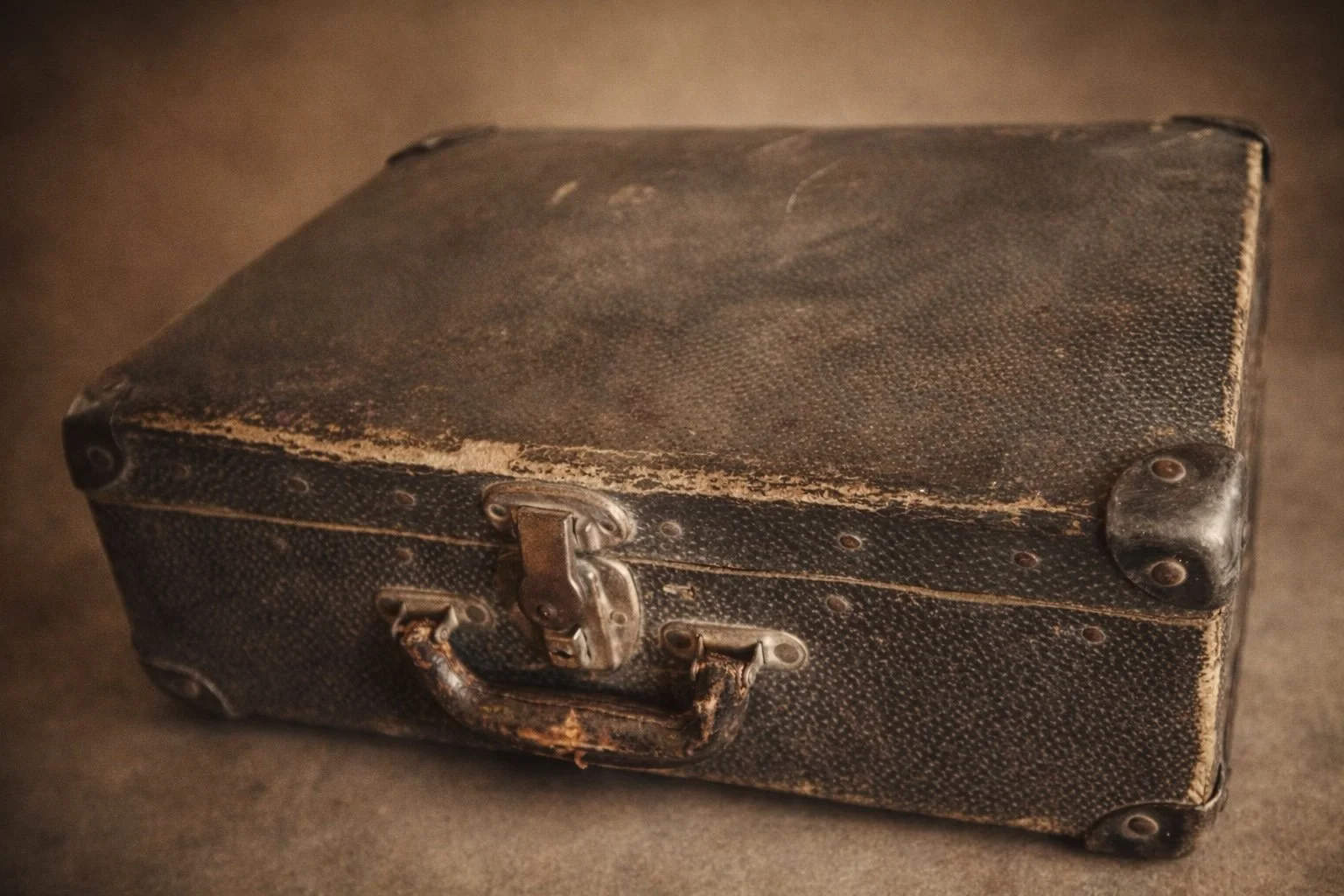
Edith’s suitcase from 1956. She kept it all her life.
This essay is part of a short series about my mother’s adoption in 1956. The scenes are imagined, shaped by the stories she carried with her and shared with me over the years. Some names have been changed to protect privacy.
A sliver of light knifed through the dark curtains, stretching a pale stripe across the unmade bed. Edith followed it with her eyes, willing herself not to look at Mama’s hands, the way they trembled as she folded a pair of tiny cotton underwear. The silence pressed between them, thick as the August heat.
“This is for your own good,” Mama said, her voice breaking.
She smoothed the underwear, tucked it beside the mint green dress in the black cardboard suitcase. Her fingers hovered there a moment, barely touching the fabric, before she shook her head. As if she were trying to shake something loose, something she didn’t want to name.
Edith swallowed, her throat dry.
“It’ll just be for a while,” Mama continued. Her voice steadied itself, like a woman fixing her hair in the mirror before heading out the door. “You’re a smart girl. Our smartest girl. You have a chance.”
A chance. The word landed in Edith’s chest, heavy and sweet all at once.
Edith dared a glance at Mama’s face, searching for something—assurance, a reason to believe. But Mama wasn’t looking at her. Her eyes were fixed on the paneled wall above her, as if it held the answer she needed.
Still, Edith nodded.
If Mama said this was the only way, she would believe her.
She wanted to believe her.
But something in her had begun to tilt.
“I can come back?” Edith asked, watching Mama’s face as she said it.
Mama inhaled sharply. Her shoulders jerked. A tight lift against the weight of her thick, curly hair, like Edith’s words were a bullet to her back.
The suitcase latched with a dull snap.
“Yeah, honey.” Mama’s voice was tired now. Flat. “You can come back, anytime.”
But for the first time in her life, Edith wasn’t sure if she believed her.
Mama looked at her watch. “It’s time. They’ll be waiting on you.”
The waiting. That’s all anyone had done for weeks now. Waited for the letters. Waited for the decisions. Waited for the adults to make up their minds, for the plane ticket to arrive. And now, at the end of all that waiting, Mama was saying, “Run along, now.”
Like it was nothing. Like she wasn’t about to send Edith into a future that both frightened her and called to her, too.
The suitcase handle was rough in Edith’s palm, heavier than she expected. She was thin for ten, all knees and elbows, still waiting for her body to catch up to itself. The suitcase threatened to pull her sideways.
Her feet wouldn’t move.
Mama reached out, resting her hand on Edith’s head. Her palm was warm. Familiar.
“You be a good girl for the Keatons,” she said. “Do us proud.”
Edith nodded, and the suitcase slipped from her hand. She wrapped her arms around Mama’s legs, clinging hard, pressing her face into the stiff fabric of Mama’s dress.
A shudder passed through Mama, just for a second, like she might pull Edith closer.
Then she pulled away.
“Go tell your brother and sister goodbye.”
Tears brimming. A throat clearing. A chin lifting.
The weight of the suitcase pulled Edith forward. She turned toward the door, the hallway stretching ahead of her, every creak of the floorboards beneath her feet suddenly louder than it had ever been before.
The house smelled of rosewater and frying oil. Afternoon light pooled on the kitchen floor. Her brother and sister’s voices carried easily through the rooms.
She took it all in.
Edith hesitated in the doorway, the suitcase shifting in her grip. The weight of it wasn’t just in her hands now. It had settled in her chest, in the space behind her ribs, pressing against her breath.
Outside, the sun beat down on the cracked sidewalk, warping the air above the street. Her brother and sister sat on the stoop, still and quiet, as if they’d been there for a while.
Rose’s arms were crossed, her mouth twisted in something between a pout and a scowl. Sam, always trying to act bigger than he was, scuffed his heel against the step, eyes fixed on the splintered wood.
“You really going?” Rose asked, her voice flat, edged with something Edith couldn’t name.
She nodded, shifting the suitcase to her other hand.
Rose huffed, rolling her eyes. “Guess you’re too good for us now.”
Edith’s throat tightened. “That’s not true.”
But Rose had already turned her head, jaw set, looking away.
Sam dug at the wood with his fingernail. “What if you get lost?”
Edith blinked. “What?”
“Or sick,” he added quickly. “What if nobody knows you?”
He hesitated, then said, “What if they don’t let you come back?”
Edith shook her head. “They will.”
Sam glanced up. “You’ll write?”
Edith nodded.
Somewhere down the street, a car honked twice.
That was the signal.
Edith took a breath and straightened her shoulders.
She wouldn’t cry.
“That’s them,” Edith said, forcing her voice to stay steady.
Sam nodded and looked away. Rose kept her eyes on the sidewalk.
No one said goodbye.
When people talk about my mother’s adoption, they talk about opportunity. They talk about rescue. They talk about the life she was given.
I think about Mama’s shaking hands. I think about two children on a stoop who never said goodbye. I think about a ten-year-old girl standing in the doorway, realizing, just for a moment, how alone she is.
This was the price of a better life.
It was paid by everyone.