Soft Armor for Hard Days
Migraines have taught me many things, most of them against my will. Chief among them: my clothes can either help me move through the day, or argue with me every step of the way. When my head is a vice and the world feels slightly out of focus, getting dressed becomes less about how I look and more about how I survive being in my body.
I’ve learned that staying in pajamas all day, tempting as it is, doesn’t always help me feel better. Of course, sometimes it’s exactly what my body needs. But on other days, it lets me drift into a low place that can be hard to come back from. So even when I’m going nowhere and seeing no one, I get dressed—not in anything ambitious, just in clothes that tell my nervous system I’m still participating in the day, even if at a reduced volume.
It’s made me curious about something I don’t hear talked about much: how we dress when no one is watching—what those choices do for us.
Over time, I’ve come to think of these clothes as a kind of soft armor. Not armor meant to harden me or make me impervious, but something gentler—layers that help me stay upright in the world without asking more than I can give. Soft armor doesn’t perform. It doesn’t chase polish or optimism. It simply creates enough structure for me to move through the day with a little steadiness, even when everything underneath feels unsteady.
Recently, in the foggy aftermath of a migraine, I tried on three sweaters in quick succession. The first was too thin for the damp winter chill, offering no real protection at all. The second was heavier, promising warmth, but the wool scratched at my neck until my ears ached. I didn’t need to think very hard about either of them. My body made its objections immediately.
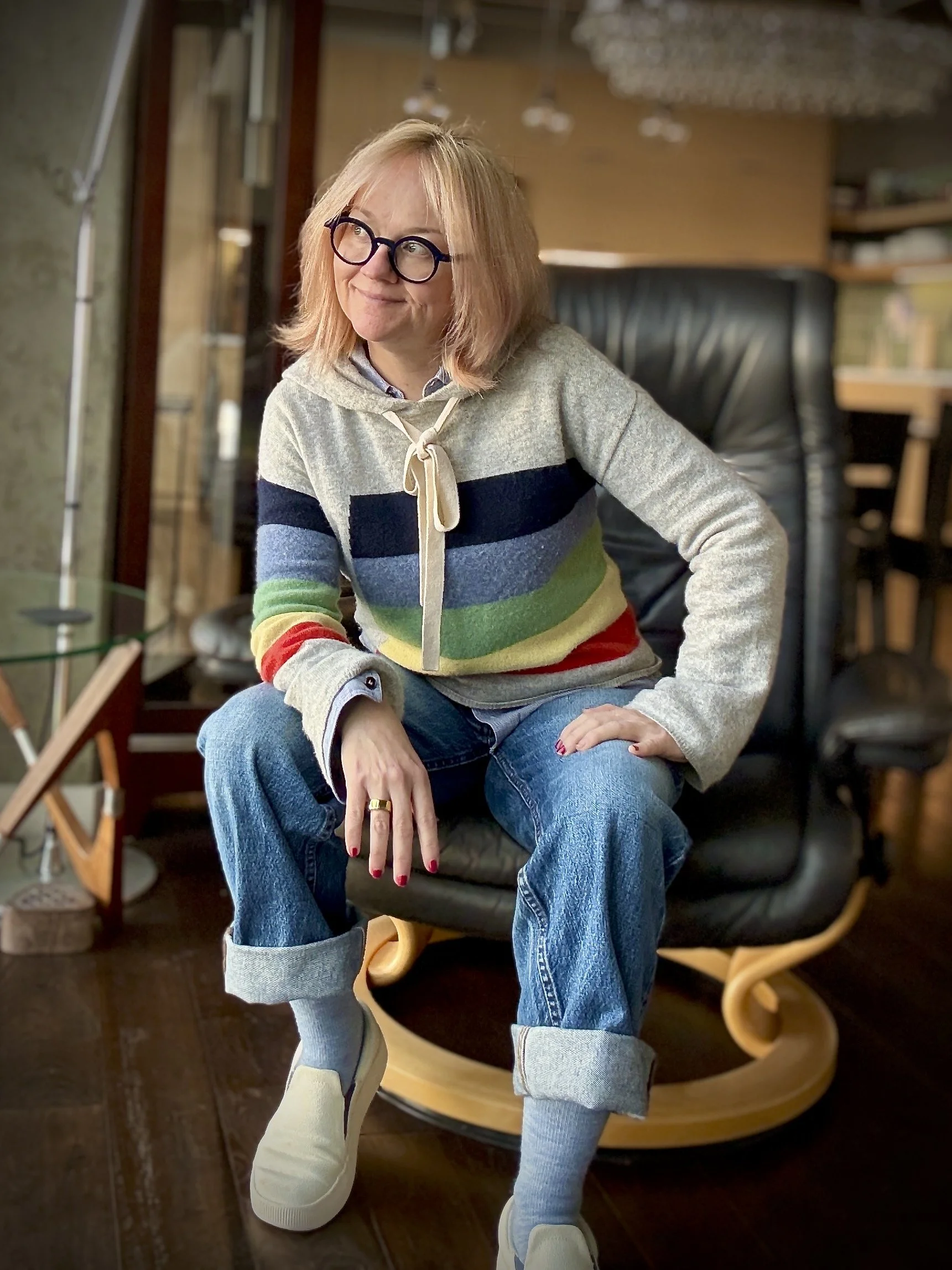
The third was just right—a thrifted cashmere hoodie with wide rainbow stripes. The fabric settled instead of clung. The weight felt reassuring rather than oppressive. I knew as soon as I pulled it on that this one was different, not because it looked better, but because my shoulders dropped. My breath slowed. My nervous system, finally, stopped arguing, and I can’t argue with that.
On days like this, I reach for jeans that are slightly too big. They aren’t loungewear. My denim doesn’t have much stretch, and it never pretends to be sweatpants, but it’s familiar, and that familiarity counts for a lot. A belt lets me decide how much pressure I’m willing to tolerate. A snug waist I can’t negotiate with is a nonstarter; a belt I can loosen or remove entirely feels manageable. I’m not dressing for ease alone. I’m dressing for something steadier: the feeling of being myself.
Just as important as what I choose is what I rule out entirely. Anything made of nylon, such as leggings, is a non-starter, migraine or not. On my body, it turns from fabric into confinement, heating my skin until I feel suffocated rather than supported. In migraine territory, these aren’t minor discomforts—they’re alarms. Learning to listen for the no has been as important as learning to recognize yes.
On migraine days, socks are usually the first thing I choose. Starting from the feet up helps build a soothing foundation. Something soft and familiar tells my body it’s being held. I have pairs I count on to cushion my steps and keep me comfortable. In that way, they’re like teddy bears for the feet, reassuring and uncomplicated. If they happen to be a cheerful color—like the pale blue pair my sister gave me—that feels like a small mercy.
Taken together, these choices don’t amount to an outfit so much as a kind of companionship. On days when my body is working hard just to stay upright, my clothes aren’t there to impress or distract. They’re there to help me move through the day I’m actually having.
I don’t expect clothes to fix anything. They can’t calm the news or erase a migraine or make hard days disappear. But they do have the power to lift me a little, to help me feel more like myself, or closer to the version of myself I’m reaching for. Style, at its best, is a kind of conversation between what’s happening inside and what I choose to carry on the outside. Even when no one else sees it—especially then—those choices matter. Sometimes that’s enough: something familiar at my shoulders, room at my waist, softness at my feet, and the steady reassurance that I’m still here.