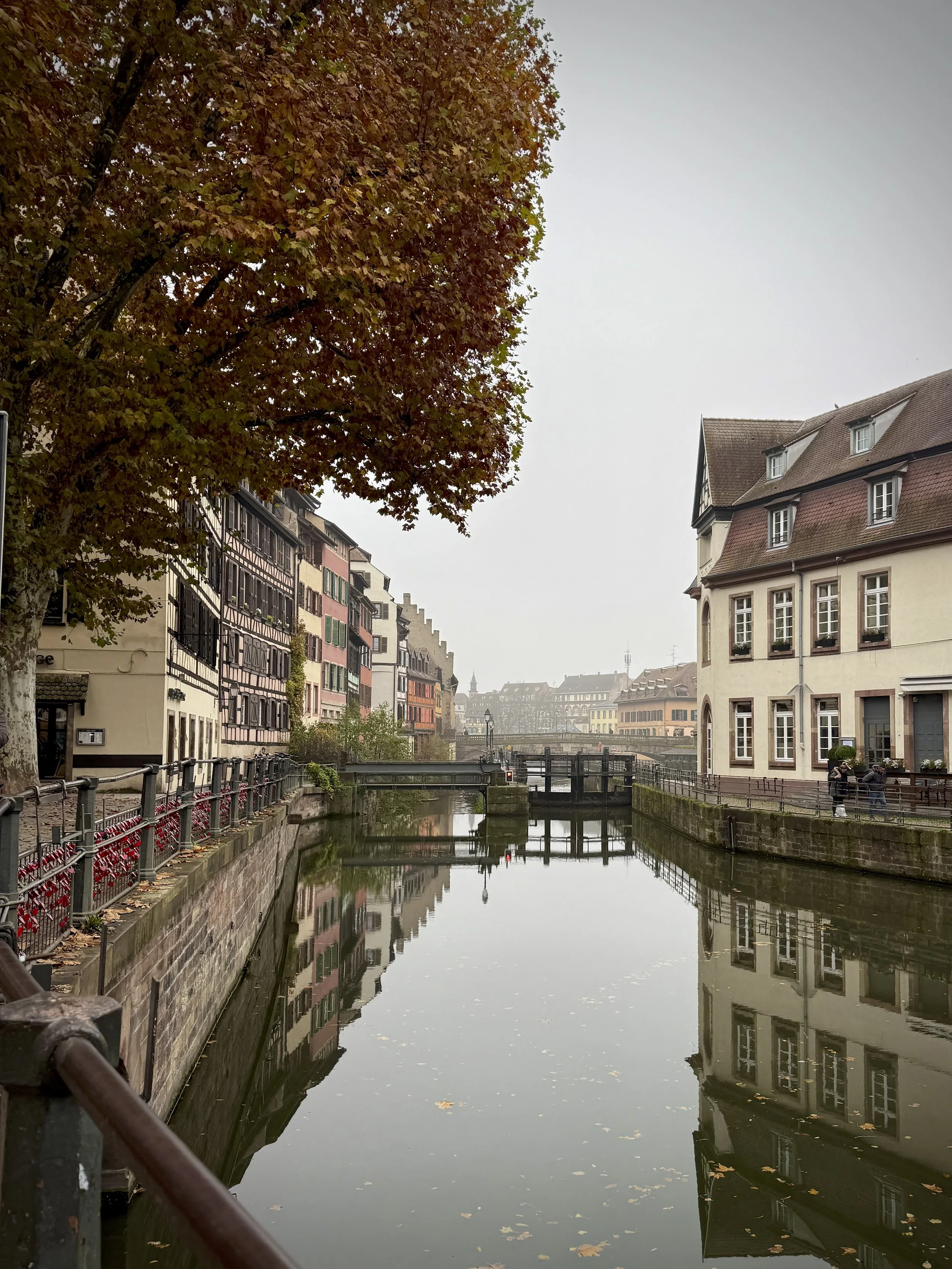
Getting Lost and Found in Strasbourg
Sometimes the world hands you the people you need most.
It was early November, the kind of cold where fog settles low over the river like glass someone has just breathed on. I was a few days into a vegan river cruise up the Rhine, from Basel to Amsterdam. It was all quiet river, castle silhouettes, the kind of landscapes that feel borrowed from a dream.
I was traveling alone for the first time in years while my husband Mike was home focusing on medical treatment. After nearly a year of battling a debilitating illness, his new treatment plan offered us hope that we’d travel together again soon. Until then, we’d agreed I should still go on this one. So on a sunny autumn afternoon in Basel, I boarded the MS Grace carrying equal parts hope and exhaustion.
That first evening, after unpacking and savoring the calm of my stateroom, I went to a gathering for solo travelers. I imagined finding another woman to wander with, someone who loved books and good conversation. Instead, it was me and three men. Kind men, but not quite what I was hoping for. Another woman arrived late, but we didn’t quite click either.
By breakfast, two of the men had found me sitting alone and joined me. They were generous and eager to connect, but their energy fastened onto me quickly, as though I’d quietly become a safe harbor. I was polite, of course, but I could feel the edges of care-taking creeping in. If I didn’t shift direction, my long-awaited trip might become another kind of emotional labor.
During those first twenty-four hours, I kept passing the same woman in different places. Petite like me, warm smile, the kind of presence that feels like a door you hope might open. We crossed paths again that afternoon, and before she could disappear into the crowd, I took a breath and introduced myself.
“Would you mind if I sit with you for dinner?” I asked.
She smiled, instantly receptive. “Of course.” Then, as if realizing I was alone, she added, “You come find us. We are always here for you, no pressure.”
That woman was Lorna.
Her daughter Shelley joined soon after.
Just like that, I felt less alone on the river.
When I first planned the trip, I imagined spending a quiet morning in Strasbourg—just me, a park bench, and a moment to exhale after a heavy year. But when Lorna and Shelley asked if I wanted to join them, saying yes felt natural, even necessary. I wanted to be with them. I wanted to see where we might wander together. I had no agenda beyond that.
Shelley was our unofficial navigator. She had mapped out our route. Lorna and I happily followed her toward the tram. Before Shelley could locate the right platform, though, an older French woman spotted us and instantly adopted us. She spoke no English. We spoke no French. It didn’t matter.
Through gestures, firm nods, and benevolent insistence, she shepherded us onto the correct tram and rode with us. She chatted brightly, tapping the map, asking where we were from. We thanked her through Google Translate. When we reached our stop, she didn’t simply wave goodbye. She walked partway with us, down a street she clearly hadn’t planned to take. A stranger who refused to let us walk alone.
Our first stop was The Great Synagogue of Peace, its pale facade fronted by a latticed wall of Stars of David. We tried to go inside, but a man with kind eyes and a cane apologetically told us visitors weren’t allowed for security reasons. A few minutes later, as we debated our next move, he came back out to apologize again and offered to walk with us toward the city center.
We walked together through air laced with cigarette smoke and a ribbon of car exhaust, all softened by the damp, foggy scent that rises from old cobblestones in the fall. After he told us his name, Mr. Weil, he shared pieces of his family’s story, how some had escaped Germany and how some hadn’t. When Lorna mentioned remembering her grandparents speaking Yiddish to her as a child, he responded in Yiddish. Something softened in her immediately: recognition, tenderness, a tiny homecoming between strangers. She glowed for the rest of the afternoon.
Before we parted, he took my hand, looked into my eyes, and said, “Good Shabbat.”
I didn’t grow up with Shabbat blessings, but the words landed on me like a soft blanket. A wish for peace. A wish for wholeness. A wish I hadn’t realized I needed. My eyes misted. I held his hand a moment longer and whispered back, a little clumsy, “Good Shabbat.”
The rest of the day unfolded gently. Shelley guided us to Cinnamood for gourmet vegan cinnamon rolls. They were warm, spiraled refuges that thawed our fingers and lifted our spirits in the way only something sweet and shared can.
With warmth restored, Lorna announced her mission to buy Strasbourg ornaments for her collection. She bought three. Because joy sometimes comes in multiples.
Later, at the vast cathedral, Shelley darted into nooks to capture photos while Lorna marveled over the religious art.
As I moved through all these glimmering moments, I kept returning to how I’d begun the trip believing I needed solitude. What I needed, it turns out, was company.
Kindness kept arriving. First in two new friends who opened their circle to me, then in two strangers who cared for us without hesitation. I arrived in Strasbourg thinking I was traveling solo. Instead, I was carried by a small river of generosity from tram stop to synagogue to cinnamon rolls to safe return.
Their welcome softened something in me. Because they made space for me, I found myself making space too. Eventually, all but one of the men from the beginning of the trip found their way into other groups. The one who didn’t often sat alone, so as our little trio expanded, I invited him to join us. He folded into our orbit as naturally as I had. Kindness widening the circle, the way it does.
Belonging doesn’t always announce itself.
Sometimes it sits beside you at breakfast.
Sometimes it walks you to a tram you technically could have found on your own.
Sometimes it takes your hand and wishes you peace.
Sometimes it shows up when you’ve been carrying a year that was too heavy and says, Come with us. You don’t have to do today alone.
By late afternoon, we were back on the ship in our separate cabins, but the feeling of being held—by new friends, by strangers, by the quiet goodness of people—stayed with me. I’d set out looking for a quiet morning. Instead, I found connection: unexpected, insistent, freely given.
And maybe that was the real healing I’d come for.