The Cats Who Ignored Me in Spain
And how their glorious indifference helped me get over myself (a little)
A solo trip to Spain wasn’t the plan. But when my travel partner disappeared into work and I found myself wandering the Alhambra with only sun, stone, and disinterested cats for company, I learned something surprising about presence, perspective—and how a well-timed feline blink can feel like emotional support.
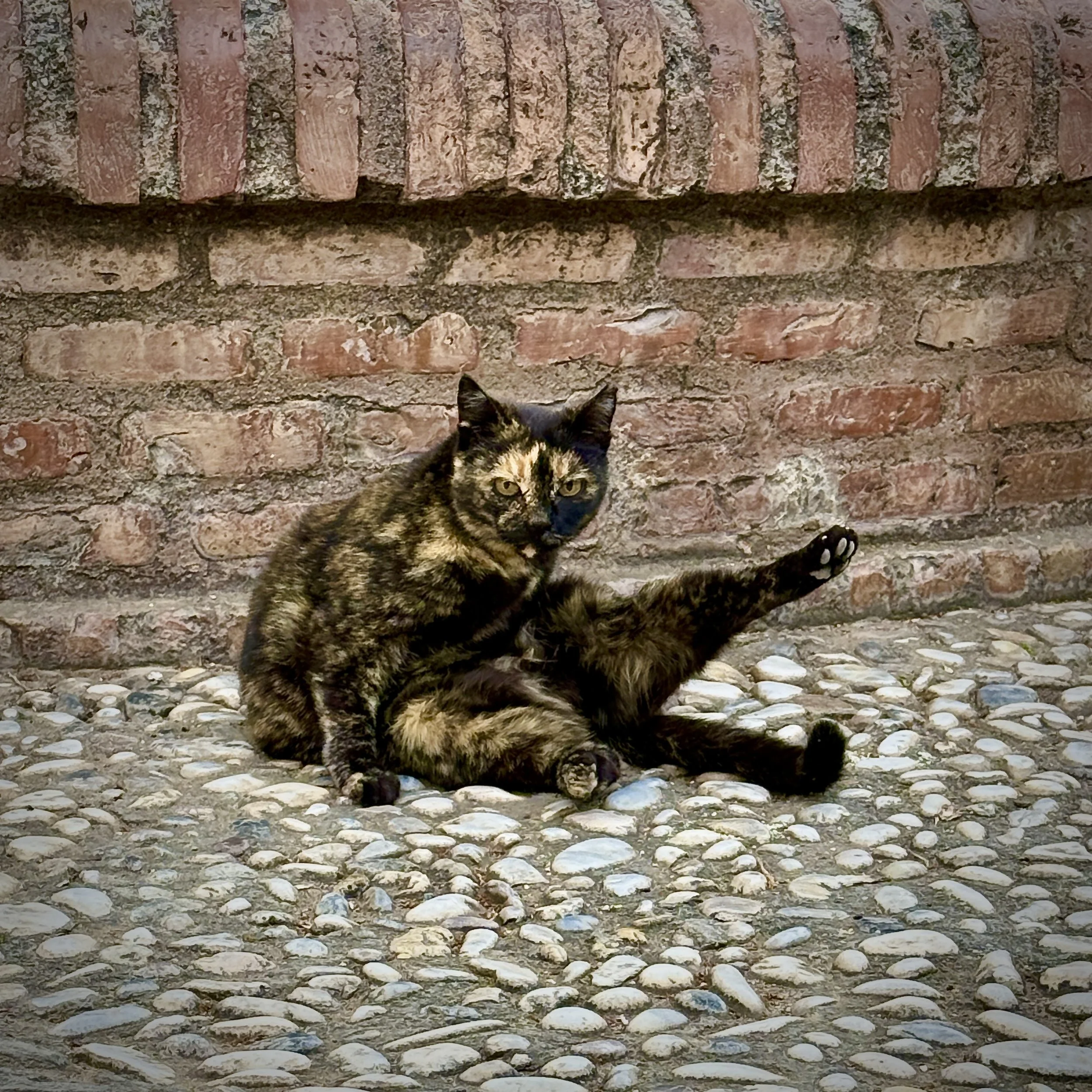
The cats of the Alhambra did not care that I was there.
In fairness, they didn’t care that anyone was there. You could have wheeled in the entire Spanish royal family, set up a tapas buffet with gold-plated sardines, and the cats might have blinked—once—before returning to the far more important work of licking between their toes.
I, meanwhile, was in the middle of a minor identity crisis.
This trip—my long-awaited, sun-kissed, tile-drenched adventure through Spain—was supposed to be shared. My husband, Mike, and I had planned it together with giddy precision: TripIt entries, color-coded tabs, whispered excitement about mosaic tile workshops. But by the time I arrived in Granada with a group of delightful strangers, I was officially traveling solo.
Not alone-alone. I was surrounded by friendly, culturally curious, possibly-more-organized-than-me Americans who had brought sketchbooks and watercolors. But the person I had imagined narrating this trip to—my person—wasn’t there. He’d been devoured by work, swallowed whole by the Barcelona branch of burnout.
So instead of sharing meaningful eye contact over gazpacho, I found myself making intense eye contact with cats.
Not metaphorically. Literal, extended eye contact. Cats who blinked slowly at me like I’d interrupted their centuries-long nap, which, to be fair, I had.
They were everywhere—perched on palace ledges, draped across sun-warmed stone, tucked into corners like ghosts who got bored and decided to stay. Each one an emotional support animal, except their support took the form of complete and utter disregard.
And weirdly, it helped.
Because while I was recalibrating my expectations—trying to figure out how to inhabit a story that no longer resembled the one I’d written in my head—the cats were doing what they’ve always done: existing. Indifferently. Impeccably.
And I thought: maybe that’s enough. Maybe being is enough. Maybe I didn’t need to document every bite or caption every fountain or explain the aching quiet I felt walking through centuries-old archways on my own.
Maybe I could just be, too.
So I tried. Not in a spiritual, capital-B “Be” kind of way. More like a lowercase-b, slightly jet-lagged, half-committed attempt to exist without narrating everything in my head or texting updates to someone who wasn’t answering. I put my phone away. I took fewer photos. I stopped imagining a documentary crew from the Women Finding Themselves Abroad channel trailing me. I just… looked around.
I looked at cats.
I looked at stones cut and arranged by people who didn’t live long enough to see the grout dry.
I looked at tourists taking selfies in front of fountains built when the word selfie would’ve sounded like a delicate 19th-century fever.
And I noticed things I hadn’t noticed in a while—the weight of the air, the way light filtered through a stained-glass window in a hotel stairwell, the breeze moving through an orange tree. The quiet.
Traveling solo in a group is a bit like being the main character in someone else’s sitcom. You’re in the mix, but your storyline hasn’t aired yet. Everyone’s lovely. They include you. They ask about your hometown, your shoes, your preferred brand of hummus. You laugh, nod, ask thoughtful questions. And all the while, there’s a voice inside whispering, Remember this. Tell him about it later.
Except you can’t.
Because sometimes, telling the story just makes the absence louder. So you shelve it. You become the library of your own experience, dust jacket slightly askew.
And then there’s a cat. Watching you. Judging you. Licking its belly.
Somehow, that’s enough to pull you back into the moment.
By the time we left Granada, I had a handful of photos of architecture, tilework, lacey archways—plus approximately one million cat portraits. Cats looking bored. Cats looking judgmental. Cats looking like they had better places to be and were also already there.
I wasn’t trying to turn them into symbols at the time. But now I wonder.
Maybe I kept photographing them because they didn’t perform. They didn’t care how they looked. They weren’t trying to be “present.” They just were. And I wanted to be like that—unbothered, unedited, at ease in my own body even when I felt out of place.
Because despite my gentle affirmations, despite the loneliness I was negotiating like a tourist map that didn’t match the streets, I was there. Not the version of myself I’d planned to be, maybe, but still: fully, humanly there.
And the cats?
They allowed it.
Without commentary. Without obligation. Without acknowledging me more than once.
Honestly? That was enough.