The Wild Beneath Our Feet
Reading time: About 5 minutes.

An image of the waterfront I took during last year’s Kinship Walk.
Before there was a city, there was a quiet that knew how to listen. The hush between waves. The breath of wind through cedar. The soft splash of a paddle dipping, rising, dipping again. Maybe an otter napped from a slick of kelp, whiskers twitching, as canoes slid across the morning water. Seagulls called then, too, their voices stitching the horizon to the tide.
For thousands of years, Coast Salish peoples, including the Duwamish, lived in rhythm with these sounds. They knew when the salmon would return, how the tides spoke, how cedar bent without breaking. Their villages and stories were shaped by the same elements that still shape us today—the salt air, the rain, the mountains watching from a distance.
It’s impossible to stand on Seattle’s waterfront today and not feel that echo, at least if you’re paying attention.
Tuning into the Waterfront
Every Thanksgiving, I take what I call my Kinship Walk along the edge of Seattle’s slice of Puget Sound. I try to tune my heart and ears to what’s left of that earlier world, the wild one that hummed beneath the concrete long before anyone thought to pour it. This year, I had help listening thanks to two books out this year: Where the City Meets the Sound by historian Jennifer Ott, and Wild in Seattle by geologist and naturalist David B. Williams. Their books bridge the centuries, guiding me through the city’s layered heart.

By the time I reached the waterfront this Thanksgiving, Puget Sound was its usual shade of steel. It is reflective, restless, and beautiful in the way only something ancient can be. I tried to picture what Jennifer Ott describes in her book: the marsh grasses and tidal shallows that once met the forest edge, the shoreline sliding north and south as the tides rolled in and out. With her words in my head, the modern city felt thinner somehow, almost transparent. I could see the old world shimmering underneath it, like an image slowly surfacing in a photographer’s developing fluid. And it made the new, spacious park—gleaming where the viaduct once loomed—feel like just another layer in the long conversation between shoreline and city, its edges softened by plantings meant to recall what once grew here.
David B. Williams’ voice joined the walk too, whispering reminders of the city’s secret wilds. Coyotes navigate the city streets at dawn, horsetails—those ancient, unkillable survivors—push through cracks in the sidewalk, and ‘glacier-riding’ erratics dot the landscape. His book makes you look with new eyes at every building, stone, and branch. It’s as if he’s saying, Look closer. You’re not alone out here. The earth remembers you.
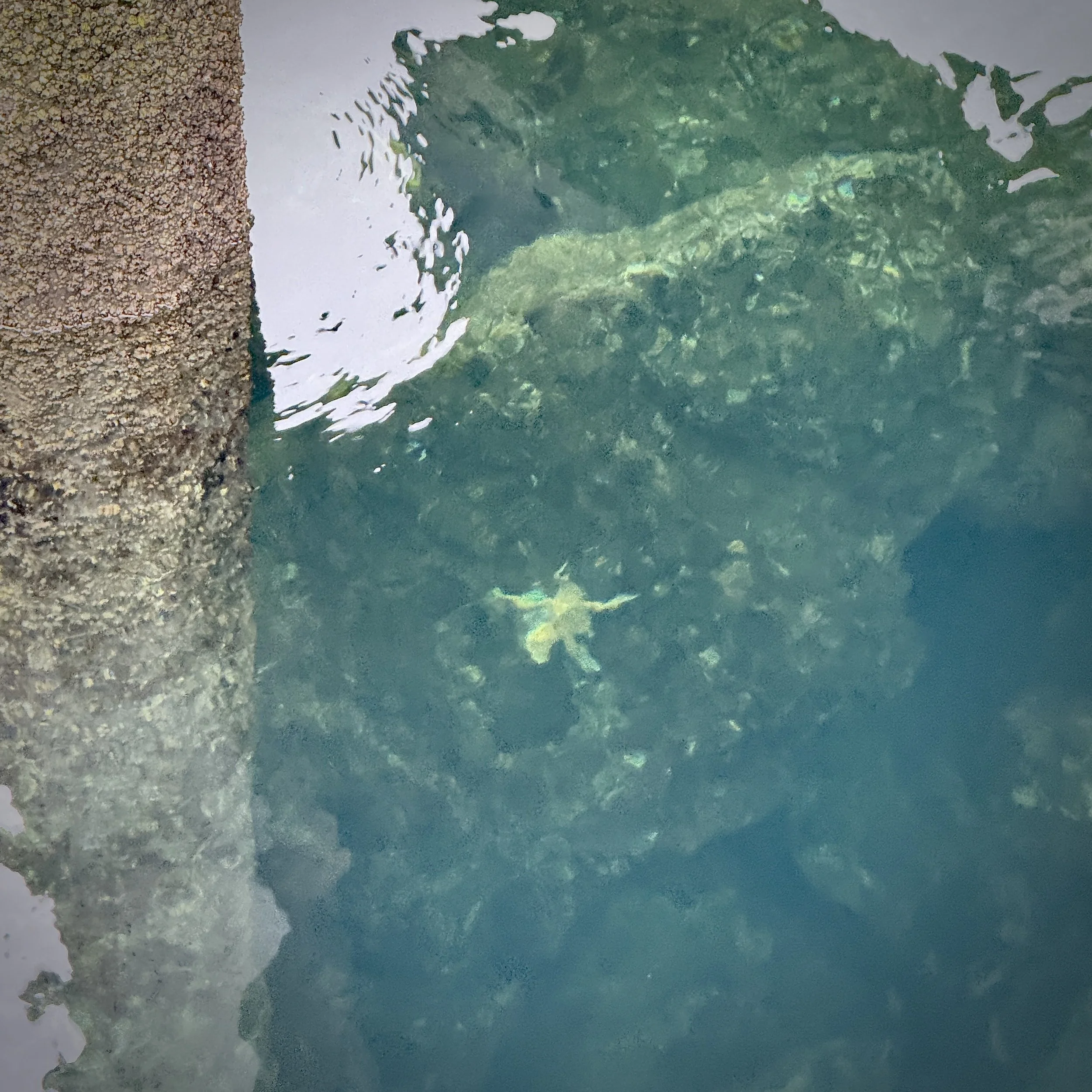
Squint and you may see the starfish “dancing” beneath the ripples of the water. How many generations of starfish have called these waters home?
So I walked slowly, as I always do. The new Ocean Pavilion rose to my left, its glass reaching toward the sky and catching the light while the water to my right murmured against nearby piers. High above, gulls glided in wide circles, crying out their usual complaints—as if the entire shoreline existed solely to disappoint them with its unforgivable lack of fries. Their calls braided with the wind, rising and falling in a way that felt older than the city itself. The air smelled of seawater and that tarry, almost-ancient scent that seeps up from old lumber docks. Down by Molly Moon’s Ice Cream shop, the cheerful little building made me think of the sweetness of freshly griddled waffle cones—the scent that so often floats along this stretch of waterfront. Somewhere between all those shifting scents and sky-born cries, I felt the older quiet return—the one shaped by tide and weather, the one that still pulses beneath and around everything we’ve built.
Seattle has its historians, its dreamers, and its walkers, but Jennifer Ott and David B. Williams are rare in that they are all three at once. Their books aren’t just about Seattle’s past or its geology; they’re about attention. They teach us to look more closely, to see the stories that have been hiding in plain sight.
Ott’s Where the City Meets the Sound reads like a time-lapse of transformation: shorelines reshaping, tides filling in, entire neighborhoods rising on landfill. Her writing slows progress just long enough for us to see what was lost and what still remains. She reminds readers that before the seawall and the viaduct, people lived in longhouses near the mouth of the Duwamish River, tending clam beds and berry patches. When I flip through her pages, it feels like she’s standing beside me on the waterfront, saying, See how the city keeps trying to meet the sea—and how the sea always answers back?
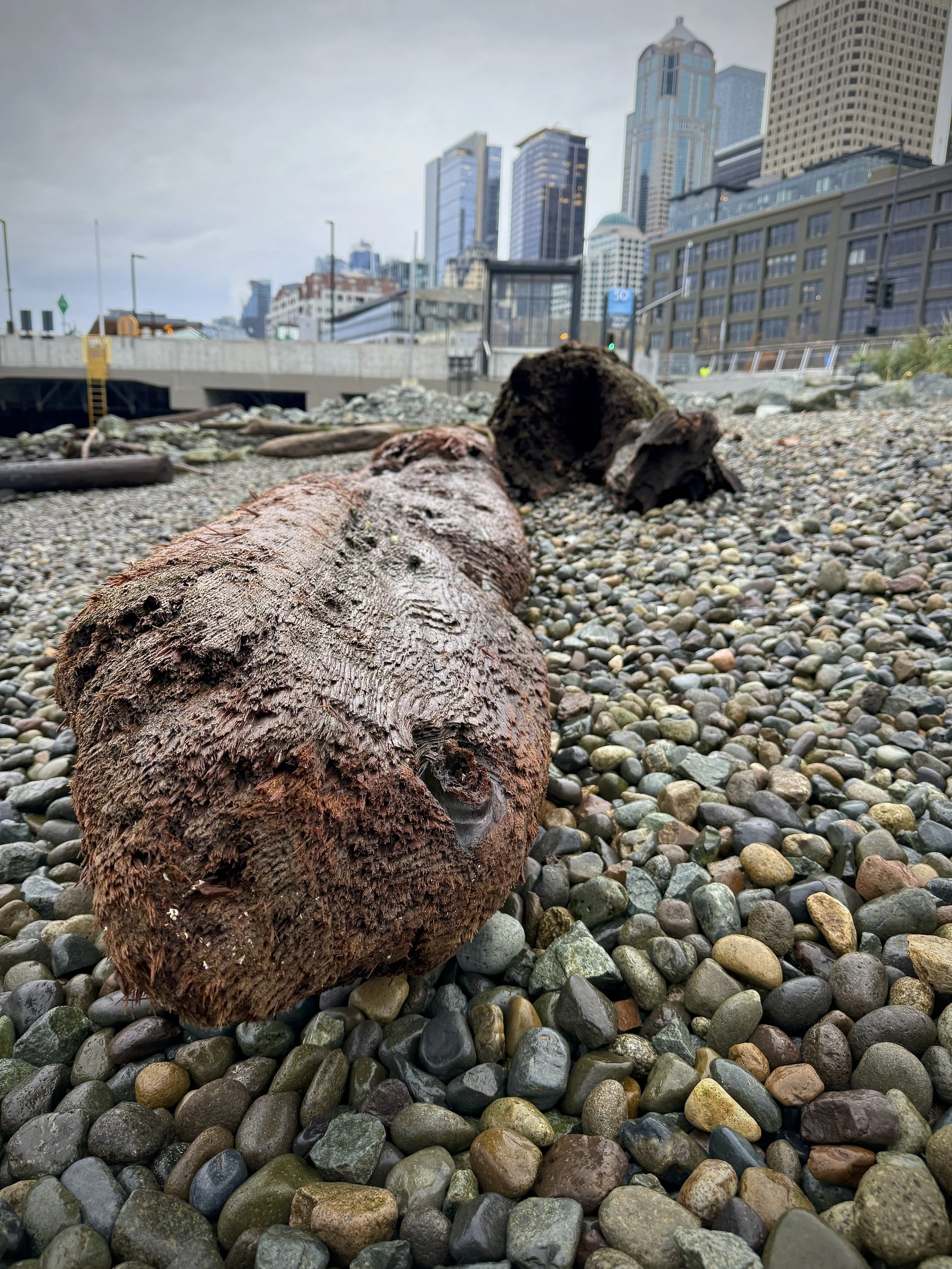
A cranky old log tries to get some rest on Pioneer Square’s Habitat Beach.
Williams’ Wild in Seattle feels like a conversation with the nonhuman city: eagles, slugs, trees, and the slow, patient work of erosion. He reveals the resilience of the natural world and honors the Indigenous knowledge that recognized it long before anyone else did. His writing makes you realize that even when we paved and polished this place, the wild simply adapted. It waited, patient and watchful, for us to notice again.
Both writers give shape to the gratitude I feel on these Kinship Walks. Through their eyes, the city becomes something alive and tender, worthy of care. They turn history and geology into love languages—ways of saying look closer, listen longer, remember where you are.
Where the City Still Breathes
By the time I turned back toward home, the light had shifted—the kind of late-November brightness that isn’t really bright but glows anyway, a quiet shimmer across the water. The gulls were still talking. The ferry was still crossing. And somewhere beneath it all, I could almost hear the paddles again.
Ott and Williams both remind me that long before this was a skyline, it was a home—first and always—to the Coast Salish peoples, whose descendants are still here, still telling stories that keep this land alive. They were the first to hear the gulls, to taste the salmon, to feel the rain on their faces and know it as blessing. When I walk this shoreline, I try to imagine the city through their eyes: not as something to be conquered or built upon, but as something to belong to.
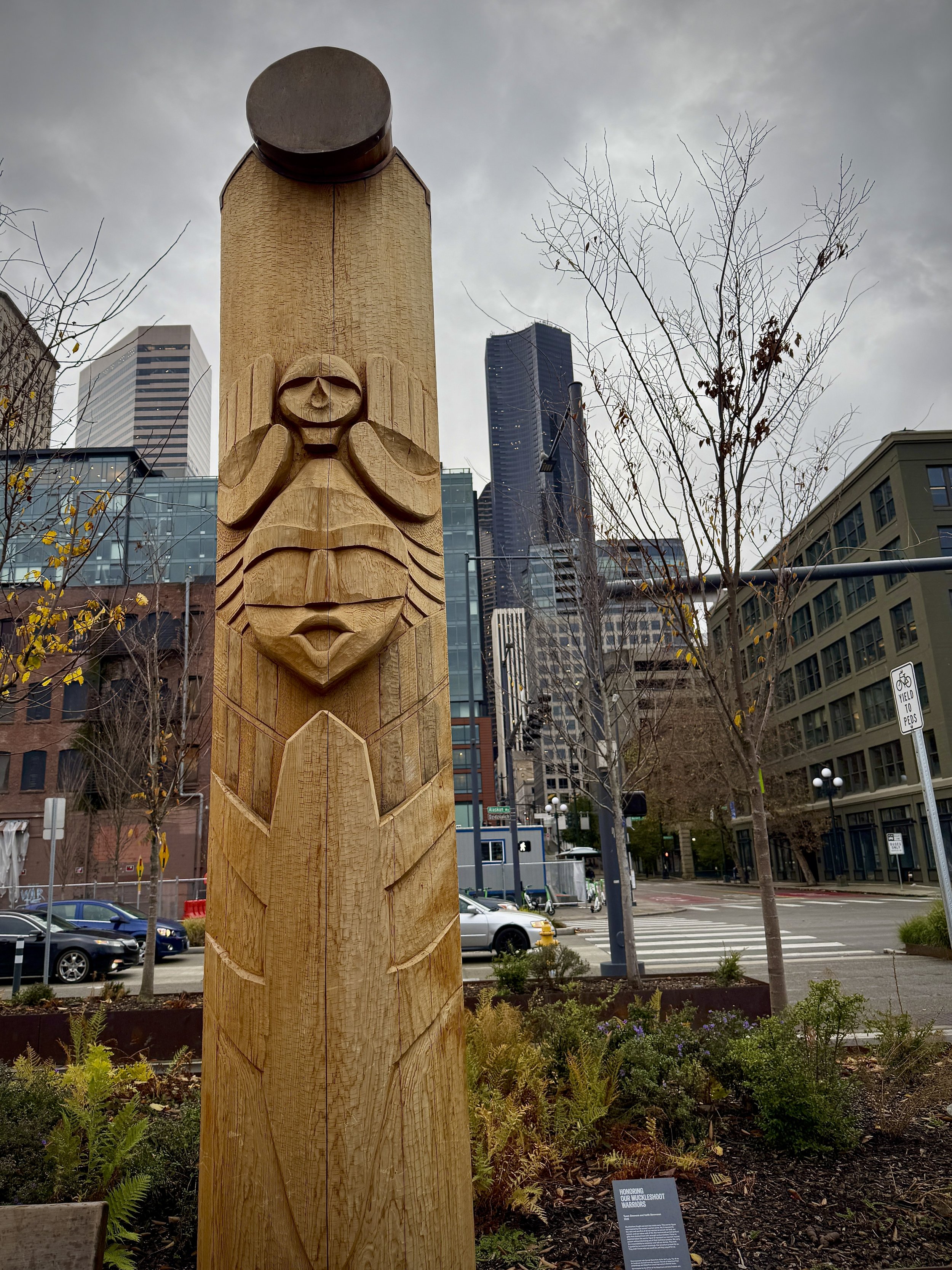
Honoring Our Muckleshoot Warriors by Tyson Simmons and Keith Stevenson, 2025: “We carry the responsibility to remember and tell our stories. The work is guided by our ancient teachings. Our ancestors prayed for us. They didn’t know who we would be, yet they prayed for us.”
It’s easy to think of Seattle as a place built on progress—skyscrapers, cranes, glass. But standing at the edge of the Sound, it’s clearer that we are built on layers of story, on choices both wise and ruinous, on a land that has never stopped breathing beneath our feet. Ott’s and Williams’ books make that visible. They remind me that history isn’t what’s behind us; it’s what’s all around us. The trick is to listen and look for it.
So that’s what I did on my walk this year. I listened. I thanked the city, the sea, and the people who came long before me. I thanked the ones who keep telling its story. And for a moment—between the wind and the waves and the chatter of gulls—it almost felt like the city was thanking me back.
May we all find a moment this season to listen for the stories beneath our feet.
P.S. For fellow Seattle-history and nature nerds: David B. Williams writes a fantastic Substack called Street Smart Naturalist, where he shares the kinds of stories that make you want to walk slower and look closer.
And for Jennifer Ott’s work, you’ll find her all over HistoryLink.org — she’s their Executive Director and one of its most prolific contributors.