When Memory Becomes Light
Reading time: About 6 minutes.
In Amsterdam, a room of paintings stirred a memory I’d carried since fourth grade—one that led me back to a beloved teacher, a ruptured past, and a doorway I finally stepped through.
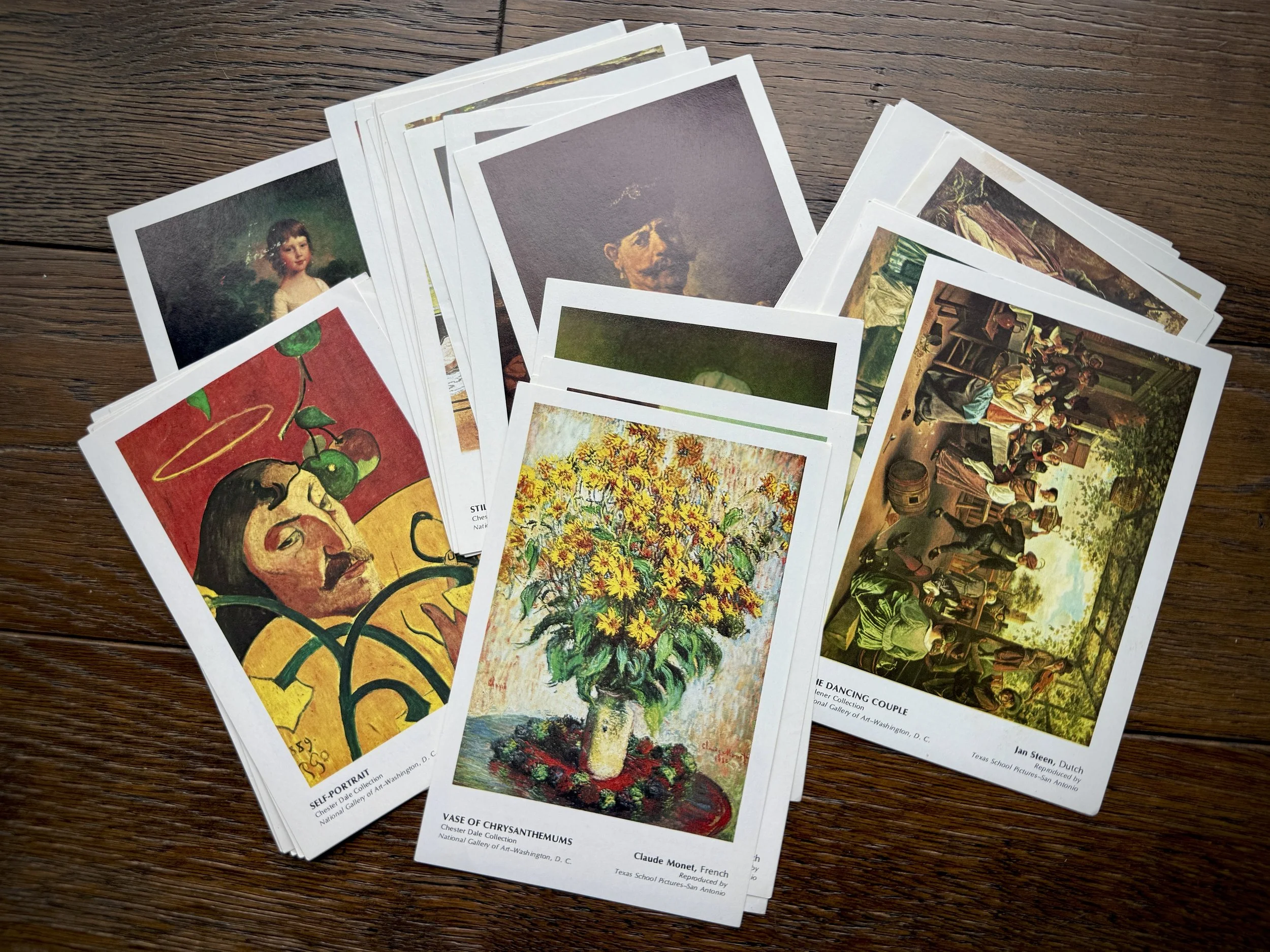
The Picture Memory cards I memorized in Texas around 1980—my first map into the world of art.
The Secret World
When I was not quite ten, growing up in the small Texas town of Clifton, my fourth-grade teacher, Mrs. Bryan, tapped me on the shoulder and told me she wanted me to be on our school’s Picture Memory team. The name made it sound like a game, but to me it felt like an invitation into a secret world, the kind only a person who really sees you knows how to open.
With a name like Picture Memory, you might imagine a grid of overturned cards and a cartoon cat waiting to be matched. But this was something else entirely. Our job was to memorize the titles, artists, and nationalities of works of art held up by history as important to humanity. Really, it should have been called The Masterworks Challenge. We competed across Texas against other kids doing the same peculiar thing.
Imagine rows of children squinting at tiny reproductions of A Polish Nobleman and Le Château Noir, saying “Cézanne has an accent over the first ‘e’” while our classmates played kickball outside. It was absurd. It was wonderful. It felt like learning a language no one else knew existed.
The Picture Memory cards we studied were glossy, about the size of an index card, with an image of the painting printed on top and the facts listed below like a miniature museum placard. I still have mine. The corners have softened over the years, the edges yellowed. Some hold the faint smell of 1980s paper and ambition.
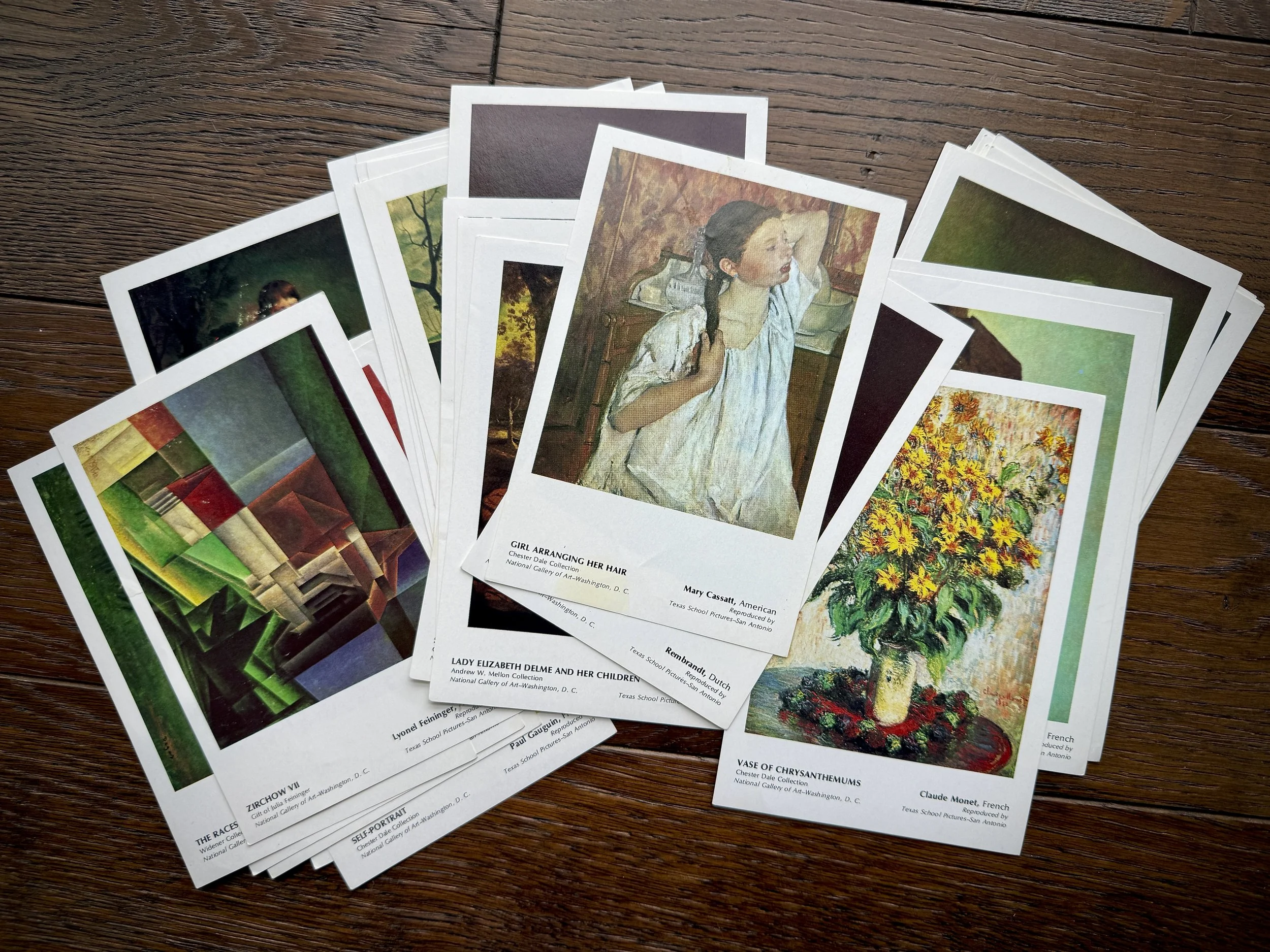
Claude Monet’s Vase of Chrysanthemums nearly defeated me. I whispered chrysanthemum under my breath for days, shaping each syllable until it finally cooperated. Mary Cassatt thrilled me—a woman among all those men. Lyonel Feininger’s Zirchow VII confused me in a way that felt almost electric. Gauguin left me equal parts bewildered and delighted.
Those cards were more than cards. They were like a map I was learning to read with reverent, wide-eyed intensity.
Mrs. Bryan must have known I needed that map.
She was warm and observant, with short chestnut hair and a simple style that made her feel almost luminous to a child. She felt steady, anchoring. She was a life raft for little kids who didn’t yet know how to name what they needed.
When she chose me, it felt like she’d unlocked a Sherry-shaped door that led to a world filled with color, museums, and names like Renoir and Rembrandt, names that felt like spells when I whispered them under my breath.
The Rupture
The summer after fourth grade, we moved away from Clifton. My new school didn’t have Picture Memory or anything like it, and my new teacher wasn’t interested in organizing any special programs. I went from feeling chosen to feeling misplaced. It was as if someone had shut that secret door before my foot fully crossed the threshold.
I missed Mrs. Bryan more than I knew how to say. During a visit back to Clifton a year later, I looked up her number and called her. I had nothing in particular to tell her. I was eleven going on twelve, what could I say? But I needed to hear her voice, to know she was still out there somewhere, steady and believing in me from afar.
Three years later, she was murdered.
The news arrived on my fifteenth birthday, and it felt as if the floor gave out from under me. She had been shot four times in the bedroom of her home. Her husband, the high school principal, quiet and bespectacled, was convicted after a tangle of flawed forensic testimony. He spent thirty-three years in prison before being paroled. New analysis now points toward a local police officer, long deceased, as the likely killer.
What rose in me wasn’t only grief for her death. It reached into the old ache as well, the childhood loss of her, and the two merged. Horror layered over longing, helplessness settled into a space that had already known sorrow. The shadows and nightmares that came afterward belonged to both.
Something inside me folded shut. She had been an anchor. Losing her severed an early sense of safety I didn’t yet know was fragile. For a long time, I couldn’t look at those Picture Memory cards. But the map they’d sketched into me—the one Mrs. Bryan started—never fully disappeared. It just waited.
The Return
Decades later, when I found myself in Amsterdam, the Rijksmuseum glowed in my mind like a small, insistent beacon. At twenty, I had visited the city briefly as a college student. I wandered canals, visited the Anne Frank House, tried to feel worldly. But I never made it to the museum, and the omission took on a symbolic shape over time. It became an opportunity missed, a door I forgot to walk through.
What pulled me back wasn’t logic. It certainly wasn’t geography; all the paintings from the Picture Memory cards live at the National Gallery of Art in Washington, D.C., a place I’ve visited many times without feeling this tug. What called me was something else: Rembrandt. Vermeer. Their presence in my childhood memories felt fused with Picture Memory, as though they’d always belonged to the same chapter of my life. They felt like childhood. Like possibility. Like Mrs. Bryan.
I needed to stand before their work. To close the loop.
So when I returned to Amsterdam in November of last year—older, softer, more myself—I walked toward the Rijksmuseum as though answering a long-delayed summons.
Stepping through those doors felt like closing a 45-year-old parenthesis.
I popped in my AirPods and followed the museum app through staircases and crowds until I reached The Great Hall. Something inside me vibrated like a metal detector nearing buried treasure. I knew I was close, but I couldn’t yet see the paintings I was looking for. And then I stepped through the doors into the Gallery of Honour.
It wasn’t one painting. It was all of them. The warm shadows. The impossible light. The stillness that breathes only from oil brushed onto canvas by hands steady with devotion.
Something moved under my ribs, and my eyes misted until I couldn’t see the painting in front of me. Portrait of a Girl Dressed in Blue by Johannes Cornelisz Verspronck blurred through my tears, reminding me of the paintings I had memorized and of my ten-year-old self.
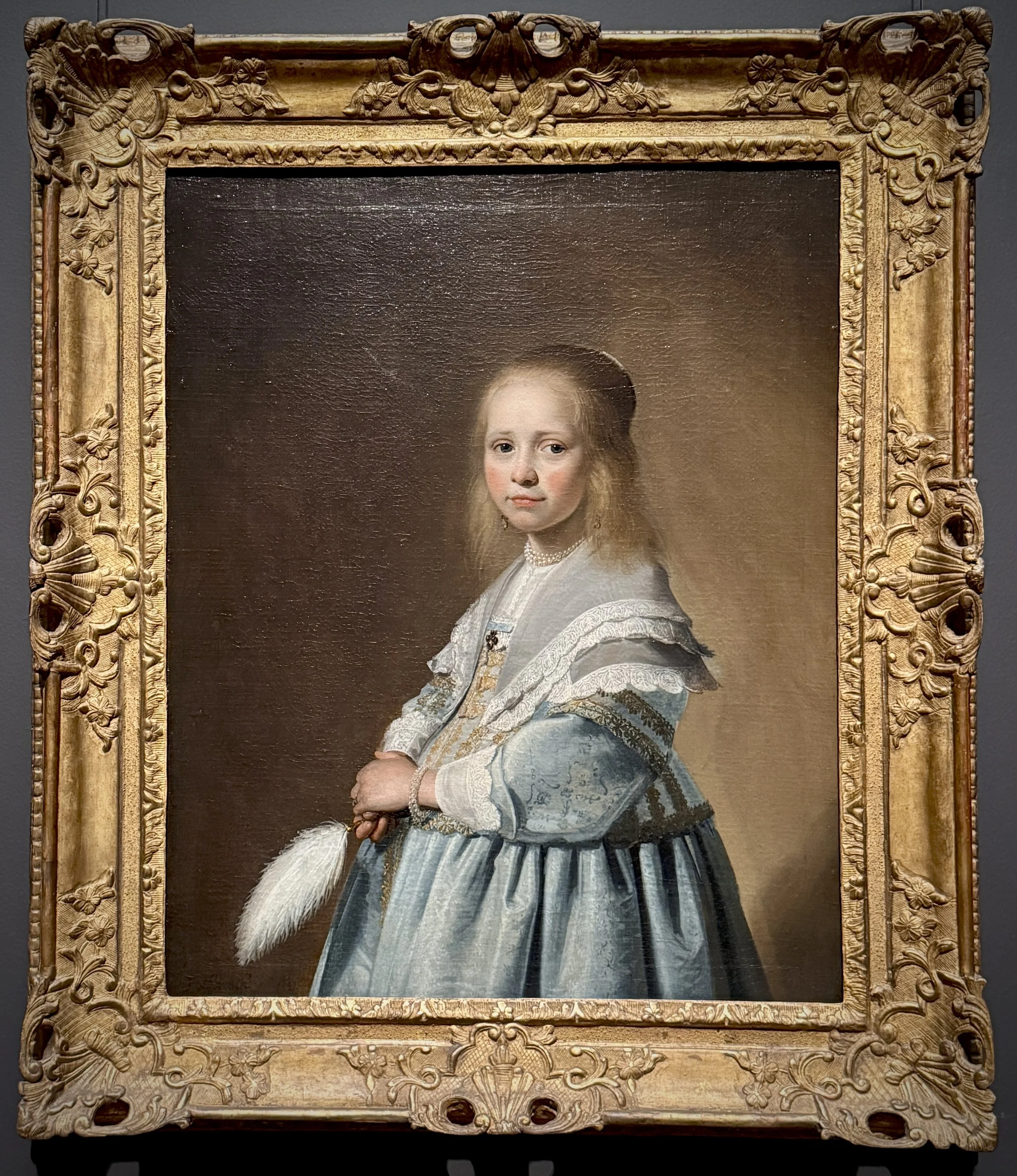
Portrait of a Girl Dressed in Blue by Johannes Cornelisz Verspronck.
That child who whispered the word “chrysanthemum” until it finally obeyed was suddenly beside me, tugging at my sleeve.
Look, she said. We made it.
And then softly, almost imperceptibly, I felt Mrs. Bryan.
Not as a ghost.
Not as an ache.
But as a presence.
A gentle hand on my shoulder.
A familiar voice reminding me to look closely at things worth loving.
Standing there among the Rembrandts, the Vermeers, the Versproncks, the past and present folded into one another like two edges of a page that had drifted apart for decades but finally met again, flush and aligned.
I stayed until the lump in my throat eased. Until the world felt stitched together in a new, old way. Until the grief and the gratitude could sit side by side without jostling each other.
When I finally walked away from the gallery, it wasn’t with the feeling of having checked something off a list.
It felt like coming home to a part of myself I had misplaced.
It felt like answering a door Mrs. Bryan had opened for me long ago, one I finally stepped all the way through.
Postscript
For those interested in the full story of Mrs. Bryan’s case and the wrongful conviction of her husband, ProPublica published an in-depth two-part investigation by Pamela Colloff. You can read it here: